
Oh good, this one picks up right after Iyobinte Pusthakam! So now I have 1900 through 2000 covered. I know everything about the history of Kerala! (not really)
Coincidentally, just today it was announced that Shahrukh is investing in modestly priced housing being built in Dubai. Gauri will be decorating it, Shahrukh promoting it. It looks like the kind of housing I saw in the opening of Ustadh Hotel and in Airlift, modest but big enough for a family. This is the kind of housing that is going to change everything about the story we saw in Pathemaari.

Let me back up first, aaaaaallllllll the way back 170 years ago when my family came to America. Well, some of it. Some others came a few years later, some others a couple hundred years earlier. But what all of my various branches had in common is that they didn’t come alone, they came as part of an entire family. Mom, Dad, multiple children, maybe a few uncles and aunts and grandparents thrown in as well. And when they arrived, they intermarried with other massive families, and built their own houses and businesses and farms and so on. Within less than one generation, they had firm roots put down and identified as “American” more than anything else.
Which was a blessing! That they were able to do that. That (with a few bumps), they were accepted into the original culture, legally and socially. And that America had so much space available, it could easily house an entire family. Literally house it, the first requirement is shelter. And thanks to the massive smallpox epidemic that preceded us by a few hundred years, and wiped out most of the inhabitants of the continent, there’s loads of space in America! And it’s all nice and fertile and easy to live in.
And that is what Mammootty lacks in this film. He has work, he has the promise of immigration, but there is no shelter, no welcome, no space for him. Which brings me back to Shahrukh’s new housing development. Now, there is space. Nice air conditioned family friendly space. No need to live constantly at odds with your environment, barely holding on to the little corner you have carved out for yourself.
I’ve been thinking about this so much, because the opening parts of the film felt so familiar to me from American immigration stories, including the ones in my own family. There is no money or work or future at home. So you tear yourself away with visions of a glorious future. You survive the terrible crossing. You are thrilled to reach land. Time passes rapidly. And then, at some point, you look back and realize what you have missed as you went rushing after the future, and what you have lost when you left your home. Fine fine fine, totally familiar to me!
(This song could be dropped into any random “coming to America” movie and feel completely at home)
But then it leaps ahead to decades later, he has become comfortable in his new land and new life, he has a family, everyone relies on the wonderful things his new opportunities have brought them and have no patience for his existential angst over what he has lost by leaving home. Okay, all of this is again familiar to me. Only, instead of his family that relies on him and glories in their new bright future being with him in the new land, they are all still back home while he is overseas. That’s terrible! You have all the difficulties of being an immigrant without the reward of seeing what your struggles have bought for your family.
Which is I think why this film is structured this way! Well, that and the need to get to Mammootty and get rid of the younger actor as soon as possible. We leap from him as a teenager eager to risk life for the great adventure of traveling over the seas, to a young married man, desperate to return home and spend what brief time he can with his loving wife. Add a mustache, and Mammootty can pull off young 30s, right? And then just keep adding grey, and you can age him all the way up to 60! Which is his actual age.
Which brings up another question, why do they always add aging make-up to movie stars when they are playing their real ages? Is it so we don’t think to much about how old they really are? I had the same problem with the Shahrukh’s make-up at the end of Veer-Zaara. Not only was it RIDICULOUSLY BAD, he was playing his own age! Ish. Maybe 5 years older. Young hero Shahrukh is maybe 25, 22 years later he is 47, why did they make him look A Million?
(Why? WHYYYY?)
At least the make-up here is really well done. On both Mammootty and his wife, Jewel Mary (I think? It is hard to tell from the cast list). Jewel Mary goes a bit over the top right at the end with the hesitant slow moving to show great age, but Mammootty is perfect through out. Changing his behavior just slightly to go from a strong and still young man, to a middle-aged man beginning to be worn down by responsibilities and life, all the way to a peaceful old age.
I’m struggling with where to put the SPOILER warning for this one, because there aren’t really any particular twists or plotlines. It’s just a life lived from start to finish. I guess the structure might be a spoiler? How it twists and turns around? So I’ll put the SPOILER for that here.
SPOILER SPOILER SPOILER SPOILER!
We start with the end, the family in Kerala gets a phone call from Dubai that their father/husband has been found dead. His sons are upset, but seem a little confused more than anything. His wife is heartbroken. Meanwhile, back in Dubai, a string of men crowd into his little room shared with 3 other men to pay their respects.
And then we go back to the beginning, when he was happy with a place of respect and a skill he could use (playing soccer on the local team), but had no money, and his family had no money, and as the only boy, the responsibility was placed on him to somehow help them survive. We see how he has been trained his whole life to take responsibility and sacrifice for the good of others. Like, when his friend, Moitheen (Sreenivas, but not yet since it is still the youthful actors) brings him food from a ceremony to take home with him. His father divides the portions between the rest of the family, and asks only after having divided it “you ate already, yes?” Young-Mammootty has no choice but to agree.
We see over and over again how his father is driving it home to him, that it is his responsibility to take care of the whole family, to go with out so they can have more. The simple answers it that his father is a jerk! He hates his son, constantly kills his dreams and reminds him of his duties because he enjoys lording his power over him. But this movie is a little more complex than that, especially in terms of male responsibilities. When young-Mammootty is leaving for the journey that he may not survive and, even if he does, he will not return from for years, his mother gives him her blessing, his sisters are upset, but his father turns away and just goes back into the house. And for one moment, while the rest of the family is together outside, and he is alone in the house, he lets his face fall and all his grief and sorrow show. It’s a lovely shot, his face in the foreground, the rest of the family shown through a crack in the door all clustered together.
See, this is the pain of the patriarch! To never be allowed to show weakness, because if he did the whole family would crumple. To never let them feel his pain. And to train his sons in the same manner. I mean, I’m not saying it is a healthy way to be, or the right way to be, but there is a nobility to it.
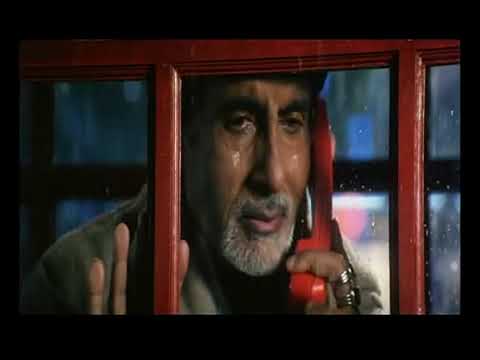
(Pain of the Patriarch! Also, the kids in this film are almost as horrible as the kids in Baghban)
And that’s why we hurry past the young part. Not just because we need to get rid of young-Mammootty actor. But because life doesn’t slow down and start feeling real until you have a family to take care of. Which is why we jump to several years later, his young wife and his now widowed mother waiting patiently at the local store in case he calls on the phone to the neighborhood store. His wife loves him, and misses him, and there is an extra pleasure in that for him.
But then he actually gets to India and it all starts to go wrong. First, the suitcase he has packed so carefully with gifts for everybody, is spotted by a customs official, and he is forced to untie the ropes around it and unbuckle the buckles, reveal all his little presents to the world, and then finally hand over cash to bribe his way back into his own country. The whole visit goes like that. Little moments of joy and excitement, quickly tarnished by demands, assumptions that he can afford to give and give and give. At least he shares this status with his wife, even his present for her, he has to hide it in a plain package under a different name so it won’t be taken by someone else. They get no time together, he is wanted constantly to be fussed over by the rest of the family. And then he returns to his exile in Dubai to find out that his mother died the day he left.
Oh, but before that there is a little moment that seems meaningless, but is super important to the theme that is revealed at the end! While he is in the hotel in Bombay, waiting for his flight to take off, a man comes in and asks if anyone is traveling back from Dubai to Kerala. He finds someone, and asks him to take a package for his daughter back to the village, but to tell her it came from Dubai, not Bombay. Mammootty is curious, and follows him out to ask why the charade is necessary. He explains that he was planning to go to Dubai, but he was tricked and lost everything, and now he is working in Bombay, but hasn’t been brave enough yet to tell the truth to his family. Mammootty takes pity on him, and gives him some money, and an encouraging word that someday he will make it overseas.
And then we leap ahead again, another several years, this time Mammootty arrives without warning, wanting to see his family as they are on a regular day. That slight bite of greed that was present in the earlier visit is greater and greater now. People have gotten used to it, him giving them things. And without all the preparation for the visit, they are less able to hide it. Even his own wife, when he suggests that he is tired of living overseas and missing out on family life, hesitates. Ten years earlier, she was desperate for time with him. Now, she is worried about how they would live and her status in the community if he returns home for good.
It’s kind of yucky, that everyone is so blatant about taking from him. But I think, maybe, it is to show how all of society in Kerala has come to rely on these overseas workers, to the point that they truly can’t stop going and sending money home. Everything would fall apart. It’s not just selfishness, it’s an awareness of how things are.
And then we get the final bit, back in the “present”, he is working at a fancy mall, filled with south asians in nice clothes and business suites, while he mops the floor as a janitor. Sreenivas greets him in surprise, they don’t seem to have seen each other for a while, although they are still close. Sreenivas has brought his whole family over, his son runs a string of successful restaurants based on the one small restaurant he was able to open after years of struggle. His daughter is married and also lives in Dubai. Meanwhile, Mammootty’s two sons are doing well, but still back in Kerala. After decades of work, he still hasn’t made enough money to build himself a home where he can retire back in Kerala. And Sreenivan puts a period on the statement of the film, when he points out that all the new immigrants, the ones who are filling this mall and succeeding, they can only make it because he and Mammootty paved the way with their suffering.
In case we missed the point, he then goes into a store to check the pricing on a lamp he wants for his dream house, and discovers that the manager/owner is the man he lent money to years earlier. While Mammootty struggled and risked his life to come on a leaky boat, only to end up doing manual labor for the rest of his life, this man was able to fly in on a plane, and eventually grow to become a wealthy and independent businessman.
It’s not just all of Kerala that needs him to keep working and struggling for society to progress, it is Dubai. Not Dubai of the millionaires who want him to build their skyscrapers and clean their malls, but the workers who followed him there. If Mammootty had given in and remained at home when he wished to, not only would Kerala have suffered, needing the infusion of cash that he invested in his relatives business, that he used to pay his neice’s dowry and his son’s education, but so would the middle-class of Dubai. The future immigrants who can bring their families with them, start small business, live in those new houses Shahrukh is building for them.
 dontcallitbollywood
Pingback: My Movie To-Do List: Let Me Know If I Missed Something! And Click the Links to See What I Have Already Covered! | dontcallitbollywood
Shoil definitely watch Paleri Manikyam where Mammootty playes multiple roles. It is a murder mystery set during the period (1956) when Kerala as a state was being formed.
LikeLike
Thanks! I’ll add it to my to-do list, if it isn’t already there.
LikeLike
Pingback: News Round-Up: Ranveer Was Cute, Gauri Khan is Impressive, and the Court Case Blackmail May End | dontcallitbollywood
Pingback: Film Reviews | dontcallitbollywood
I just discovered this review. I saw Pathemaari a little later than you, so it’s just as well I didn’t read the review first. The story of the people in India relying on cash from abroad isn’t limited to Kerala. In all parts of India, there are people working in various Middle Eastern countries, not always happily, whose families are living it up in India. To an extent, this is true of the people who emigrated to places like the U.S., too.
The only jarring note of the review for me was too much intrusion of SRK. Really, I know you are his fan, but please don’t drag him into everything. It can be off putting to even people who like him (like me) but aren’t head over heels in love with him.
LikeLike