
I was in the middle of writing a 101 on Pakistani film when I realized I can’t really do that without talking about the relationship between Hindi and Urdu, and I can’t do that without talking about South Asian languages in general, and thus we find ourselves here.
Non-Usual Disclaimer: I am not a linguist, nor am I a South Asian. This discussion is more based on history of South Asia and general Orientalist theory than on anything specific to the various languages and how they grew.
Sexy sexy Edward Said, in his 1978 book Orientalism which dropped like a bomb into the academic world and the aftershocks are still reverberating, identified the “science” of “linguistics” as one of the major weapons of the colonial powers. They used language to label people and place them in neat little categories. And once they were labeled, they used the “study of language” to create tidy stereotypes that those people could fit into. And finally, they used those stereotypes to justify colonialism. This group is incapable of abstract thinking, as shown by their language, and therefore need a wiser group to guide them. This group is misogynist, as shown by their language, and therefore their women need to be protected. The British/French/German/Whoever are more logical, more intelligent, more capable of higher thought, as shown by their language.

(You know how Shahrukh is sexy both because he has that fascinating face, and because he has that fascinating mind? Edward Said, same thing.)
Obviously, there is also a legitimate study of languages, languages do exist in the world as a thing you can learn and discuss, and many linguists today (including some I know) are nice people who don’t draw massive stereotypes from their research but just tiny little conclusions like “it seems like there is a connection from here to here based on the matching vowel slippage between these two groups”. But the aspects of linguistics that Said identified have also lingered into the present, especially in colonial societies where the people were trained by colonial powers for generations to see language as a battle ground.
In India, there are multiple language based battle grounds. Some of them based on the kind of linguistic differences that are clear and absolute, some of them based on linguistic differences that have been affected by politics and history along with language. And some both.
I’ll start with the biggest thing to know about. In India, there are two major language groups, Indo-Aryan to the north and Dravidian to the south. Don’t think of them as French versus German, think of them as more like French versus Mandarin. Different alphabets, different sentence structure, no shared loan words, truly totally different languages. I am sure those of you who, like me, started with Hindi films and moved to southern have noticed this. None of your painfully acquired Hindi knowledge is useful for any southern language industry.

(There was also a theory popular among European linguists in the early 1900s that Indo-Aryan was the parent language for all of Europe, based on certain words and vowel sounds. And therefore the Aryans were the essential original conquerors of Europe. That theory has been more or less debunked today, but it is the reason Hitler picked the term “Aryan” to describe his group, and used the mutated version of a Hindu Swastika as a symbol.)
But what about within those two groups? Well, it varies. Some of the languages within the Indo-Aryan or Dravidian groups are as distant as, say, Spanish and French. Several shared words, a similar grammatical structure, but you can’t really understand or speak one if you know the other. Others are more like Yiddish and German, a variation on a base that is still so close if you speak one you can more or less understand and be understood in the other. And some are as close as British English versus American English, essentially the same language with a few distinct pronunciation and vocabulary differences and slightly different accents.
The problem is, the British decided that some of these languages should be considered simply “dialects” and some should be considered totally different languages, in a way that doesn’t necessarily match with the reality of how they are used. So, for instance, Punjabi and Hindi are considered two separate languages despite being so similar that the speaker of one can easily understand the speaker of the other. On the other hand, the Telangana dialect of Telugu was not considered its own language, merely a variation on Telugu.
(Sai Pallavi in Fidaa speaks Telangana. The hero speaks a modern common version of Telugu. They understand each other, but she has a distinctly different sound.)
Over and above all of the dialects present in North India and (a little bit) in south India was the general language called “Hindustani”. Hindustani used the basic grammar and structure of what we know today as Hindi/Urdu. But within that it had regional variations, loan words and phrases and oddities based on the language that was common in whatever particular area it was within. “Urdu” is the version of Hindustani spoken within the Mughal courts. It has many loan words from Persian and Arabic. And it was used for great poetry, and religious writings. This is also the shared language of Islam in India, as Islam spread along with the Mughals. You will find people in south Indian Muslim enclaves like Hyderabad who speak Urdu, although they are living within a Dravidian community.
During the debates around the constitution and what Independent India would look like, there was a strong argument for “Hindustani” as the official language. The language of the streets, of traders, the language most people shared just a little bit. But the debate eventually changed and instead Hindi (a specific version of Hindustani) and English became the official languages of the national government. Nehru, concerned about the need for national integration, wanted all states everywhere to start using Hindi as a shared language. Which is when a new, post-Independence and colonialism, battle of language began.
In Tamil Nadu, there were murmurs of succession related to the language issue. Tamil is one of those languages that is not merely a dialect of something else, but is truly its own language. With its own massive history of novels and poetry and religious texts, all of its own. And of course, also films. A group of men, long time freedom fighters against the British, got together and founded the Dravida Munnetra KazhagamIn (DMK) after Independence to fight against northern aggression specifically related to language. One of the youngest of these men was M. Karunanidhi, a screenwriter for the Tamil film industry. The DMK, and later the break off AIDMK founded by movie star MGR, continue to this day to look at their greatest purpose and meaning as the protection of the Tamil language.
( Prakash Raj plays M. Karunanidhi in Iruvar. Or he would, if Iruvar was based on a true story, which of course it is not as clearly explained in the disclaimer before the film.)
Nehru also wanted state boundaries within India to follow lines that would lead to national integration, rather than ethnic strength. This is a battle he is still losing. Over and over again, the map of India has been redrawn following ethnic and language patterns, most recently the people of the Telangana region of Andhra Pradash (the Telugu speaking state) were granted their own smaller state.
The thing about languages is that they are a moving target. And lines on maps are fixed. The history written down in books is fixed, dictionaries and grammars are fixed, and do not reflect what is actually happening day by day. Before the British arrived, India had thousands of years of language shifts that happened without anyone trying to label them or mark them one way or the other. They just were what they were. The British arrived and marked things and labeled things, languages and national boundaries and ethnic identities and religions. Suddenly things that had just happened were now formal and official and impossible to change. You couldn’t be a person who celebrated Eid and Diwali, you had to mark down on a list if you were Muslim or Hindu. And in the same way, you couldn’t be a person who spoke Hindustani, you had to be someone who spoke Punjabi to your family, Hindi to your customers, and Urdu to the tax collector.
Indian film played a big part in both creating these boundaries and breaking them down. The version of the language spoken in the major film industries became something everyone knew and understood. Along with the version spoken on the radio, and later on the TV channels. This isn’t just Hindi, all the major languages had accents and regional variations that were not reflected in the “official” version which you heard on TV or in movies. The tiny regional variations began to disappear.

(Simran in A Peck on the Cheek worked as a newsreader, as did Katrina in Bharat. This is different from being a reporter, you aren’t writing or finding the news, you are just reading what someone else has written. Not an uncommon job for a middle-class woman, all that was required was the ability to speak the language in a proper clear way. But that skill was truly a skill, not something you could find from any woman on the street. The way newsreaders speak is not the way the common person speaks.)
At the same time, the identity with those larger language groups was strengthened through the art forms that used it. Tamil, obviously. Also Telugu, Bengali, Malayalam, and on and on. Being able to watch films in that language helped keep it alive in the world, and in the hearts of those who spoke it.
And then there is Hindi. Hindi films were designed to be watched through out North India and to a lessor degree south India. The Hindi in films is not usually related to the Hindi you would hear anyone speak in real life. Partly because it is more poetic (the influence of the early Urdu poets who wrote film dialogue), but also because it is simpler, easier, purer. There are almost no “loan words” from other languages, as you would hear in Hindi spoken on the streets. No strange little grammar oddities or unique phrases that pick up on the region (or city, or neighborhood) where you live. When you do hear that, it is note worthy, it identifies a character as particularly “Punjabi” or “Bengali” or whatever else. Versus “normal” , meaning someone who speaks proper watered down newscaster style Hindi, the kind of Hindi you can understand if you learned it in school. While other languages may have created proper versions of themselves for the films, similar to what folks in cities would speak in slightly more formal settings, Hindi went a little bit farther. The “proper” version of Hindi we hear in films is not something anyone in reality actually speaks. Hindi as it would be used by those who speak it as a first language is filled with specific regional variations that are erased in the film version of it.
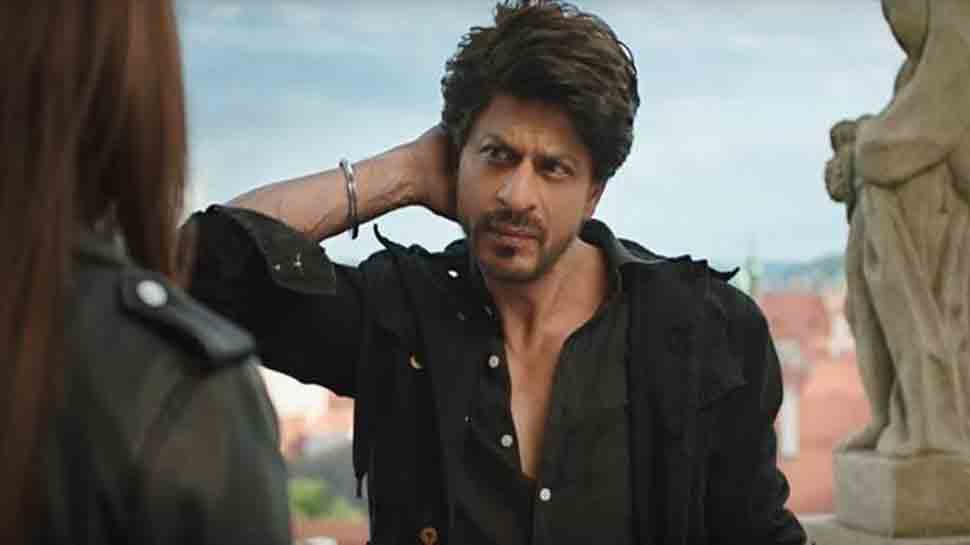
( Remember how in JHMS, Shahrukh’s character keeps slipping into Punjabi slang that Anushka can understand word by word but not what it means as it is used? Because she is Gujurati, she might know Gujurati slang but would only know “proper” Hindi as taught in schools. Normally in his job Shahrukh speaks “proper” Hindi, the clear simple easy version. This is the shading of languages that is true in reality, the fluent Hindi speakers usually have regional variations and slang mixed in, only those who learned Hindi as a second language in schools speak it as it is usually spoken in films. )
The funny thing is, since language is a living thing, the enforced borders have actually worked in some respects. The biggest border is of course the one between Pakistan and India. And therefore between Urdu and Hindi.
Urdu and Hindi use different scripts, the written versions are completely different. But the spoken versions are the same language. As close as British English and American English. In the early years of Hindi film, back before “Hinglish” became the norm, it was a big advantage if an actor spoke the Urdu dialect of Hindustani. It meant they could pronounce the Hindi dialogue with greater clarity and purity, similar to the advantages of being a Shakespearean trained actor even when performing in a play written in modern English. It’s still true today, if you listen to the dialogue delivery of, for instance, Amitabh Bachchan or Shahrukh Khan (both trained in Urdu, Amitabh thanks to his father’s poetry and Shahrukh because his mother was from Hyderabad) versus Varun Dhawan or Ayushmann Khurrana, there is a big difference.
But as the years have passed, the shifts between Pakistani Urdu and Indian Hindi have grown and grown. More and more Arabic words have been purged from Indian Hindi, while Pakistani Urdu no longer has loan words from any languages beyond Arabic, Persian, Punjabi, Sindhi, and Baloch. Even without speaking Hindustani fluently, it is easy to see when watching the films from both countries. They share the same vocabulary and grammar, but they no longer sound the same.
And on the other hand, the differences between Tamil and Malayalam, for example, have grown less and less as trade and work travel and marriage between those two states has increased post-Independence. In the same way Punjabi and Hindi are ever closer as the Punjabi refugees spread through out India and brought with them their version of Hindi (very present in the Hindi film industry, for example).

( Yash Chopra remained attached to his Punjabi identity his whole life. The classic Yash Chopra hero, straight through to Jab Tak Hain Jaan, is a Punjabi. Complete with Punjabi slang, Punjabi social traditions, Bhangra music, and all the rest. )
The big thing to know about languages in India is that you can’t rely on the simple answers. If they are simple, they are wrong. Even when there are different language film industries, it may not be because the speakers of one language cannot understand the other. The Punjabi versus Hindi industry is less about language and more about settings, a style of humor, a kind of music, an essential “Punjabi-ness” that is not present in the modern Hindi films and has lead to the rapid growth of a Punjabi industry in the past couple decades. The popularity of Urdu soap operas is not just because the language is the same as Hindi, but because the culture and narrative style calls back to shared tradition.
Oh, and also that if you try to mess with Tamil, the Tamilians will get very very VERY upset. That’s the one certainty in an uncertain world. Don’t mess with Tamil.
( 1939, 1,198 protesters arrested including 73 women and 33 children during a protest against compulsory Hindi classes in schools in Tamil Nadu. 1953, a protest over a town name being Hindicized from Tamil lead to the deaths of two protesters. 1965, 50,000 students marched in Madras asking that English rather than Hindi be the official language of the state, at the same time riots started through out the state, up to 500 dead, ending only when the Prime Minister of India agreed that Hindi would not become the only official language of Tamil Nadu. 1968, riots started again because Hindi was still taught in schools, Hindi films played in theaters, and so on, this time the Chief Minister intervened and agreed that the language of instruction in Tamil state schools would be Tamil and English only, never Hindi. 1986, a new national school system would bring Hindi back into Tamil classrooms, 20,000 DMK members were arrested for protesting and burning the constitution, and 21 protested by public suicide through self-immolation, Rajiv Gandhi agreed not to start the new schools in Tamil Nadu, the only state where they are not present to this day. 2017, this song comes out and is a massive hit through out Tamil Nadu. Really, do not mess with the Tamil language. )
 dontcallitbollywood
Sai Pallavi doesn’t speak Telangana. Nobody speaks Telangana. It’s not a language. If anything, the whole reason Telangana and Andhra Pradesh became one state in the first place was because Telugu was the commonly spoken language in both.
LikeLiked by 2 people
I never say “Telangana language”, I say “Telangana dialect”. I also do not say Sai Pallavi speaks it, I am referring to her character within the film Fidaa. Fidaa was widely promoted as showing a Telangana heroine and the Telangana region and that Sai Pallavi had to learn to speak in that accent. As I say, she and the hero understand each other but their dialogue has a different sound even to untrained ears. I don’t know how I could possibly have been clearer or more accurate in what I am describing, they are using the same words but it sounds different.
I am not sure why you would think I did not understand exactly what is meant by Telangana versus Telugu, or why the state was formed that way, or how languages, dialects, and accents can relate to each other, based on the discussions I put in the rest of this post in terms of language, statehood, and everything else.
On Tue, Jul 23, 2019 at 3:27 PM dontcallitbollywood wrote:
>
LikeLike
“Sai Pallavi in Fidaa speaks Telangana. The hero speaks a modern common version of Telugu.”
Also, there’s no such thing as the Telangana dialect (not that that’s what you wrote anyway). There are multiple dialects spoken all over Telangana.
LikeLike
I used the word “Telangana” without a modifier one time in the caption of an image. Essentially what you are asking is that I add the word “dialect” or “accent” after the word “Telangana”. Which I am not going to do, because after considering the context and everything else, it doesn’t seem worth it. You can take that as my disregarding your comment, and I suppose it is in a way, in that I read it and did not find it something that made me decide to change what I said. The biggest question is, why after reading this whole long in depth post is your only response to pick at one small element? How do you see this potential change as affecting the bigger arguments, why is it important enough for you to bring up in a comment?
On Wed, Jul 24, 2019 at 9:15 AM dontcallitbollywood wrote:
>
LikeLike
Ya it seems nit picky to argue on a simple wording. There definitely is a “Telangana” dialect; it is more than an accent since some words are imported from Marathi, urdu etc. Also “Andhra” also has multiple accents in the state such as “Rayalaseema” “Godavari” , “North Andhra” etc, but these aren’t dialects since language is mostly the same.
LikeLike
Just curious, is there one of those accents that is considered better than the other in some way? More high class or something? Or are they all equal? Or does it depend on where you are from in terms of how you regard them?
LikeLike
“Just curious, is there one of those accents that is considered better than the other in some way? More high class or something? Or are they all equal? Or does it depend on where you are from in terms of how you regard them?”
Sorry, your below question was not showing a “Reply” button, so replying here.
The only places they don’t call as accents are “Krishna” and “Guntur” districts, there is lot on consensus calling them true Telugu accents. All remaining accents have some other language influence, such as “Rayalaseema” has Tamil and Kannada influence, not sure of “north Andhra” may be odia influence etc. The language they use in telugu movies for “serious” and “Dramatic” discussions is from these 2 districts.
LikeLike
If I am watching a regular Telugu movie, not something like Fidaa where they specify a region of the state, are they speaking with the Krishna or Guntur accent you would hear anywhere or is it a made-up movie kind of accent (like the movie-Hindi seems to be)?
And thank you for being so patient with my questions, this is all a new area for me (both languages and southern stuff) so I am trying to learn as much as I can.
On Wed, Jul 24, 2019 at 1:19 PM dontcallitbollywood wrote:
>
LikeLike
Until last decade, no matter what area the movie was based of, the Hero(Protagonist) always spoke “Krishna/Guntur” telugu. Lot of “faction” movies used to be based of “Rayalaseema” but hero never spoke those accents , only antagonists and other characters did. Now its changing in films such as “Baadshah” “Aravinda Samatha” “Fida” etc they are valuing other accents and most importantly “normalizing” them. Sorry for lot of quotes, they are needed there.
I don’t think any accents in Telugu movies are madeup except the ones spoken by “NRIs”. Those are definitely madeup since they use same accent no matter if he returns from UK, France or US.
Speaking of accents, i don’t think non-speakers can recognize them but there are lot of half madeup half true accents in Telugu movies involving people from outsides such as “Tamil people speaking Telugu” , “Malayalis speaking Telugu”, “Marwadis(rajastani) people speaking telugu and generic north indians speaking Telugu. They are lot more funny if you can recognize.
LikeLike
Thank you! I was wondering if that was the case. I can’t hear the accents, but I can see the clothes and hair styles and so on, and in those areas there definitely seems to be a line of “the hero is cool and urban and modern, even if he is surrounded by people who wear something else”. Sometimes the film will explain it, but sometimes it seems like even if the hero in theory was raised in the village and all his family wear old-fashioned clothing and mustaches and stuff, he will still be modern and cool.
LikeLike
Thats quite true, since “Authenticity” always comes in the way of good Entertainment which Telugu people like 🙂
LikeLike
Fine by me! I like entertainment too, if I wanted an accurate depiction of rural life in India, I’d watch a Malayalam film.
On Wed, Jul 24, 2019 at 3:16 PM dontcallitbollywood wrote:
>
LikeLiked by 1 person
I’m sorry if my comment sounds harsh, but in an earlier comment you have mentioned that you don’t like it when I don’t respond to your critiques, so here is my response.
On Tue, Jul 23, 2019 at 3:27 PM dontcallitbollywood wrote:
>
LikeLike
I think what I’d mentioned was how you twist things around to make the argument that the critique wasn’t applicable to you. Not that I didn’t like it, just that that seems to be your approach.
LikeLike
This is what you said:
“I’d been wondering if I’d “imagined” some of what I was seeing on this blog, but this comment confirmed I wasn’t. This is not the first time I’ve tried to provide missing context, thanks to which you were completely misinterpreting something, and seen a response that says you stand by the misinterpretation or couldn’t care less about the context.
Anyway, this is your space – not mine. You do you.”
What you are seeing is that, yes, I stand by my original arguments. In some cases context provided is irrelevant (for instance here, the question of exactly how to describe Telangana has nothing to do with the main points of this post, besides proving them since one of my main points is that defining a “language” is impossible). In other cases, the context provided is simply wrong. Either way it is not something I can really reply to since there is nothing substantive to say.
I am trying to respond now because this is ultimately a public forum and while generally I trust my posts and my writings to stand for themselves, I am worried that leaving comments unanswered might end up lowering my authority by implying I am agreeing that I am wrong and am too ashamed to respond. And also because you are a commentator who specifically opened up the discussion and suggested you would welcome such a response, unlike my other occasional anonymous commentators who make similar statements.
On Wed, Jul 24, 2019 at 9:17 AM dontcallitbollywood wrote:
>
LikeLike
So in response to my comment saying that you tend to respond to critique with “Doesn’t apply to me”, you’re essentially saying that it doesn’t apply to you. You’re right – this totally proves your authority.
LikeLike
What did you expect me to say?
On Wed, Jul 24, 2019 at 12:00 PM dontcallitbollywood wrote:
>
LikeLike
Great post. Hindi being considered the national language when in reality it is one of the official languages along with 21 others has led people in the South learning it as a language in school along with the specific regional language. As such there is a much larger audience for Hindi films in the South while in the North there is not much of a market for non-dubbed Southern movies. This has led people to believe Rajnikanth represents the whole of Southern movies. Also in Hyderabad what others think is Urdu is actually Dakhani or Daccani. You should watch Hyderabad Nawabs as an example of Dakhani language movie. The scenes with Hanif Bhai in that movie are a riot.
LikeLike
Thanks for the comment and recommendations!
The effect you describe of Hindi being learned in schools and influencing the film audience is I think maybe even more so in the diaspora? Hindi being the common shared language in some of the cultural centers overseas, and Hindi being the common language you can use with a new friend in class or your taxi driver or whatever. Does that make sense?
LikeLike
I feel that people use English to communicate with each other (at least in the US) when it comes to the diaspora? Granted I’m a first-generation immigrant who only speaks English with parents that don’t speak any Hindi whatsoever (I suppose there have been quite a few North Indians that have tried to speak to us in Hindi so maybe you’re on to something) so I don’t know how accurate my observations are
LikeLike
Piping in to second this comment. Also, I think diaspora kids now have far more access to regional language entertainment than I ever did growing up, With specific language satellite TV, streaming services, much more consistent theatrical releases and the fact that there’s just more Indians (I’m mostly referring to the US), I find kids now are way more aware of regional pop culture than I was. In their early days in America, my parents would sometimes watch Hindi movies with friends even though they didn’t speak the language because they were home sick and it was as close as they could get. That’s not really necessary anymore.
LikeLiked by 1 person
What I am seeing in the box office is a growth of non-Hindi Indian options at the same time as a decline of Hindi box office. Which I think is reflecting what you are saying, it’s not that the southern stuff is bringing new audiences to the theater, it’s that the audiences that used to settle for Hindi stuff are now leaving Hindi and going to the southern films now that southern films are available.
On Tue, Jul 23, 2019 at 6:12 PM dontcallitbollywood wrote:
>
LikeLike
The way how Urdu has been linked to the whole South Indian Muslim identity is very interesting because I’m not entirely sure how applicable it is to everyone? Don’t know for sure but I heard that Muslims in the southern states primarily speak the regional languages and that only a small percentage of Pakistanis speak Urdu as their first language. I do know for sure that Bengali Muslims while they may use loan words do not speak Urdu. Part of the reason why East Bengal/Bangladesh ended up succeeding from Pakistan was because of the opposition of the usage of Urdu and the omission of having Bengali be an official language
LikeLiked by 1 person
That’s part of the reason I decided to write this post, I started to write about the Pakistani film industry thinking it would be more straight forward than in India, that there would just be the one Urdu industry. But no!!!! There was Urdu, and also Punjabi, and Sindhi, and a little bit Baloch. It’s just like in India, everyone speaks a little Urdu, but only 7% have it as their first language. It’s just like in India, with Hindi dominating because it is the sort of watered down vaguely familiar option among the many many regional languages, but in Pakistan it’s Urdu.
On Tue, Jul 23, 2019 at 5:49 PM dontcallitbollywood wrote:
>
LikeLike
Only the Muslims in Hyderabad/Bidar/Bijapur etc. that were under the rule of Muslim rulers like Nizams, Golconda Nawabs, Bahamani sultans speak Urdu and Deccani (Dakhani) which is Urdu influenced Hindi. Muslims in rural South India speak native language like Telugu, Tamil with some Urdu influence – learn and speak Urdu only within their community in Madarsa type institutes.
LikeLike
I wondered about that, so in Madrassas in India, you learn Urdu, not Arabic? Is Urdu the language that most Koran’s are written in, rather than Arabic?
On Thu, Jul 25, 2019 at 4:21 AM dontcallitbollywood wrote:
>
LikeLike
To be honest, I do not know much in detail about Madarsas in other parts of India. I was quoting only those in my South Indian Andhra town where there’re separate learning centers/schools for Muslims that teach Quran and Urdu.
LikeLike
Better answers/viewpoints than mine are available –
https://www.quora.com/What-are-the-biggest-cultural-differences-between-North-Indian-Muslim-and-South-Indian-Muslim
https://www.quora.com/If-a-local-Telugu-Hyderabadi-sees-a-Muslim-will-he-or-she-talk-with-the-Muslim-in-Hindi-or-Telugu
LikeLike
Thank you!
On Fri, Jul 26, 2019 at 12:59 AM dontcallitbollywood wrote:
>
LikeLike
This is fascinating and explains a lot about why I haven’t been able to get into most south Indian films. Hindi films are intended to reach a broad multicultural audience while south Indian films are very, very specific to their regional cultures in ways that makes them less accessible to outsiders like me.
Also, there’s a woman, Samantha, who is married a Tamilian and is learning the language and she has a fervent online following and now I understand better why, it’s not just the novelty of a white woman learning an Indian language but very specifically a white woman learning Tamil.
LikeLike
Something else I notice about Hindi films, you don’t miss as much with the subtitles. Since the language in most movies (especially the newer films) is so super simple and basic, the English subtitles can usually more or less capture it. But with the southern films, for instance the recent comedy Oh Baby! that I reviewed, losing the language really means you lose the film. There’s no way for subtitles to capture it.
Another thing I am curious about with the diaspora, I know the second generation is losing their language, I am curious if they can still get the subtleties of the film dialogue. Or maybe if the southern films will start using simpler dialogue or simpler stories? It’s already kind of working with Robot and the other big Shankar films, the dialogue is good if you can understand it, but you can enjoy the films without. Versus Mani Ratnam, for instance, where I know I am really missing things without the Tamil.
On Tue, Jul 23, 2019 at 8:32 PM dontcallitbollywood wrote:
>
LikeLike
Love this post, so interesting. Thank you, Margaret and commenters.
LikeLike
Thank you!
On Tue, Jul 23, 2019 at 10:27 PM dontcallitbollywood wrote:
>
LikeLike
Modern linguists think of ourselves as the people who attempt to divest others of their linguistic prejudices. African American Vernacular English isn’t lazy or bad grammar or slang! No language is more logical than another! You can use “literally “ to mean whatever you want, as long as you and your interlocutor understand each other!
This was quite interesting and informative, and I just have a tiny bit of pedantry: there is no linguistic difference between a dialect and a language. As the saying goes, a language is a dialect with an army and a navy. Decisions on what’s a dialect and what’s a language are always, if not completely arbitrary, based on politics and convenience. Hence, the mutually intelligible “languages” of Serbian and Croatian, and the different “dialects” of Chinese, whose speakers can’t understand each other at all.
LikeLike
It almost feels like make-work, colonial linguists totally messed up the world, and now modern linguists have to go around fixing it. But then, I majored in History in college, and it’s the same deal for modern historians, going around writing books that fix the colonial view of things. And modern ethnographers and modern geographers, really the entire field of social sciences is like 70% just fixing the mistakes of the past. Stupid colonists. I would say “stupid racists” but then race and the subsequent prejudices are also totally invented by the same idiots. Which I guess is the thing that the modern geneticists are rushing around trying to fix.
And I love your dialect-language line! It makes me feel better about the confusion I have always felt about things like why Urdu and Hindi and Punjabi are all considered different languages, and yet I can kind of understand all of them?
On Wed, Jul 24, 2019 at 6:00 AM dontcallitbollywood wrote:
>
LikeLike
I find the Urdu-Hindi difference fascinating because you can really hear the poetry in Urdu even if you can’t speak it. Like when I watched Mughal-e-Azam I was struck by how gorgeous everything sounded. I recognized words the way I do with Hindi but the cadence and how it was used was very different.
LikeLike
Yes! And it feels like part of reciting Urdu poetry is dropping into that cadence? Like, it doesn’t sound right if you rush through it the way you would normal talk. Another thing that reminds me of Shakespeare, or the King James Bible, if you say it in sentence blobs the way you would normally speak English, it sounds terrible. But if you break it down and speak in a rhythm with each word pronounced, it sounds like Shakespeare.
On Wed, Jul 24, 2019 at 11:41 AM dontcallitbollywood wrote:
>
LikeLike
I don’t know if this comment belongs here or in your Humsafar posts (seen Humsafar in its entirety but haven’t caught up with your posts). I agree with Alissa and you on the Urdu-Hindi question. But whether it’s the poetry in Urdu or the fact that Pakistani actors speak much more clearly, or the cadence that Alissa describes, I found I understood much more of the dialogues in Humsafar than in most Hindi films.
LikeLike
I had the same experience! Which doesn’t really make sense, since I learned Hindi from the films, so film-Hindi should be my “native” language. And yet the version in Pakistani shows and films is so much clearer to me.
On Thu, Jul 25, 2019 at 11:07 AM dontcallitbollywood wrote:
>
LikeLike
Completely agree with all these comments about Urdu vs. Hindi. I will admit I partially watch Humsafar over and over again just to hear Fawad and Mahira speak. It is almost mesmerising.
LikeLike
Your description and list of events involving Tamils might make them look little extreme, but as a Telugu person, i understand their point of view since this has been going with them since few centuries back even before British entered the picture. Even though other south states don’t take this extreme stances, they do also posses ethnic and linguistic pride , but they aren’t that outward. All other states have adapted hindi and tech them in schools with “Tri-Language” Policy, but , most of them don’t turnout to be eloquent speaker, they just understand minimum to survive and get the grades. Andhra and Telangana are little more receptive , but its similar case. Thats the reason collections for Hindi movies is very low down south. Even though other southern states don’t share their the sentiments of tamils in this case, they should thank tamils for their battles resulting in avoiding linguistic colonialism. To give a closer to home example for you, of how southern states(for example Telugu) feel about Tamils and their struggle is, being a southern state, Texas “understands” Alabama, but doesn’t want to be Alabama.
LikeLiked by 1 person
What a lovely way to describe the situation!
It’s interesting, I was thinking about it in terms of the central government and Nehru not realizing what they were doing. But this was kind of what they wanted, right? They thought all of India should be a homogeneous unified whole. And the Tamil protests were therefore actually correct, Hindi was the start of a government policy of wanting to erase ethnic differences to create a new India. Without that strong stand, cultures (history, language, literature, everything) outside of the Hindi region could have become invisible.
From the outside, I can tell you that the Hindi policy has succeeded in that, as an American, I had no idea about the southern-northern divide in culture, language, history, everything until I started getting seriously into the films. I am now increasingly aware that what I learned about as “India” was more accurately “Northern India” and I have to start almost from scratch to understand the south.
On Wed, Jul 24, 2019 at 12:56 PM dontcallitbollywood wrote:
>
LikeLiked by 1 person
There was even a more instance of establishing Hindi primacy through National Education Policy that led to protests in many states. Last week a Postal Department recruitment exam was cancelled because it was offered only in Hindi and English.
LikeLike
Yeah, it seems clear that at some level it is still a goal of the government to get India down to two languages, and maybe eventually just one. Again, not necessarily an evil goal, but one that does seem strangely unaware of why people might hate it.
LikeLike
This is one of the unfortunate situations where, both are right in their perspectives but ground realities clash. This is just my view/opinion , Nehru was highly educated, he was aware of Chinese who were strong, he studied in Europe, familiar with french revolution, unification of Germany etc. All events points to strong homogenous population building strong countries. Probably he might have thought India needed that since at the time of independence India was very poor with limited resources and natural fissures or faults would widen if left as it is and he wanted to unite India ; since British left, only thing he can use is Hindi language. Which went horribly wrong down south , where ground reality was different and people weren’t welcoming that. His plan would have or have not worked , nobody knows but India was changed at that moment where “Unity in Diversity” came to light more than just unity. Ironically Just before Tamil riots, whole India was united against china during the 60’s war. Nehru should have known that and backed off regarding language policies, realizing no matter what when it comes to outsiders, Indians are always united. Fun fact, at the time of formation of “andhra Pradesh” by merging of Telangana region in 1956, Nehru was vehemently against it. His words came true decades later when the state split again.
LikeLike
And the funny thing is, thanks to global investments and jobs and so on, it looks like India might be increasingly united by language after all, only it is English instead of Hindi.
LikeLike
Actually, that’s kind of what a lot of the leaders of the Dravidian movement anticipated and preferred. Quoting Annadurai:
“Since every school in India teaches English, why can’t it be our link language? Why do Tamils have to study English for communication with the world and Hindi for communications within India? Do we need a big door for the big dog and a small door for the small dog? I say, let the small dog use the big door too!”
LikeLike
So in his vision, everyone is bilingual? English is the link language and the local languages survive as well?
On Thu, Jul 25, 2019 at 1:41 PM dontcallitbollywood wrote:
>
LikeLike
I remember seeing this lovely cartoon from Shankar the political cartoonist in one of those old magazines from the 60s. Jawaharlal Nehru is standing next to a child bride which is the newly independent India.The caption goes “Can’t we wait for the bride to grow up before conducting the wedding?”
Another cartoon from Shankar dealing with the same issue
https://www.thehindu.com/features/friday-review/art/pictureperfect-politics/article4262073.ece
LikeLike
I can’t figure out if Nehru thought a national shared language was a good idea in the abstract and then was surprised by the backlash, or if he knew all along what a problem it would be and decided it was worth it? Either way, it certainly looks like he dug in his heels a bit in response to the opposition.
On Thu, Jul 25, 2019 at 1:31 PM dontcallitbollywood wrote:
>
LikeLike
(I couldn’t reply to your post directly)
So in his vision, everyone is bilingual? English is the link language and the local languages survive as well?
Essentially, yes. The logic being that being if I have to learn a foreign language to use as a link, why not pick one that’s foreign to everybody so no one gets an unfair advantage.
LikeLiked by 1 person
nice post I want learn all languages.
LikeLike