What a satisfying movie! The heroine does everything I want her to do and her “punishment” for being outspoken is much less than I feared.
Swara Bhaskar is so great. In her public statements, she is always fearless and aggressive, never apologizes. But she will explain, she doesn’t start fights for no reason, she is thoughtful about when she chooses to act. And I have to think she took similar thought before agreeing to star in this film. It was written for Huma Qureshi, an actress who took a difficult role at the start of her career but, since then, has seemed to become scared of controversy, chosen to protect her small success instead of taking leaps. While Swara was making this film, Huma was playing the love interest to Akshay Kumar and Mammootty and Rajinikanth. Swara in this movie is no one’s love interest. There is no man to protect her, on or off screen. This small odd movie rose and fell on Swara alone, she took the blame for it and also the praise.
Not that the rest of the cast is bad. Pankaj Tripathi and Sanjay Mishra are excellent, as usual. And the rest of the cast of no name actors are quite good, especially in the way they build little stories in the background, for example the dancer who has a crush on Mayur More, all implied through little glances and stolen moments.
Ultimately thought, it is Swara’s film and she carried with her everyone else. That’s what this movie is showing, the way a woman can only find success and freedom by throwing herself in front of loaded guns and trusting them not to be fired. You have to be fearless, you have to earn your freedom every day, because the dangers you face will never lesson or disappear. The enemy isn’t men, it is fear of men. Men can only kill you once, but fear of them will kill you every moment of every day.
What was really interesting in this film is that we see the actually moments when Swara needs to be scared in life are far fewer than the moments when she could be afraid. That is, as a woman performer most of the time her audience was enthusiastic and joyful and happy. Her neighborhood respected her. She had friends and a house of her own and a life of her own. Letting go of fear opened her up to a whole world. The one performance where the crowd was rowdy, the one man who stalks her, is avoiding that worth losing out on all the other performances where the audience is joyful and all the male friendships with men who respect and like her? For some woman, yes, it is not worth it. But for other woman, the risk is worth the reward.
SPOILERS SPOILERS SPOILERS SPOILERS SPOILERS SPOILERS SPOILERS SPOILERS
This is a movie about a modern day Tawaif. That is, a woman who performs loaded erotic songs, but is not a prostitute or a stripper. She is an artist. She is independent, she is respected among other artists, and she chooses this life. But in order to do her art and make money at it, she has to take risks.
One thing I was very aware of watching this film is the etiquette of this type of performance. I have a close friend who performs like this, erotic dances. She makes her own costumes (or half the time, I make them for her), she comes up with her own routines, she hones them through working with other dancers in the community, and she is proud of what she has accomplished. The places where she performs she is always 100% safe and the small audiences who see her are 100% respectful. But she can’t make a living at what she does, only enough to cover expenses with a small profit. It is a hobby and a passion, not a career.
In this movie, Swara is in a world where you can make a living, a very good living, doing what she does. But only because she is also willing to accept the risks. A big audience and a public performance means it is possible that not everyone there will know the “proper” way to behave. And those who do know the “proper” way may not be enough to balance out the others. At my friend’s performances, if a patron tried to touch her or grab her, they would be stopped not just by the official bouncers but by the other patrons. More than that, they probably wouldn’t have even gotten in the door. It is word of mouth advertising, people who have seen a show before and already know what to expect will recommend it or bring friends. You won’t just stumble on these events without knowing a little about them in advance. And that includes what is, and is not, allowed. Throwing money on stage, allowed. Handing money to the performers, allowed and encouraged. If the performer gestures somewhere (breast, waistline) and indicates you should put money there, also encouraged. Dancing with the performer when she moves off the stage and into the audience, welcome. On the other hand, touching the performer without her indicating an invitation, never okay. Jumping on stage during the performance to dance, never okay. Using the promise of money to play with a performer, draw her towards you and then hold it away, allowed but rude. Most of all, not understanding the line between the performer and the person, NEVER OKAY.
In the world where my friend performs, everyone uses fake names. Obviously fake names, that is part of the performance. They know and the audience knows that this is not a “real” person, this is a persona they put on and off for performances. The people they know through performances, fellow artists, use those names, their family and friends outside of performing use their real legal names. If an audience member sees you in real life, it is understood that they don’t actually know “you”, they know that person you created onstage who is someone else entirely. If a fellow performer sees you in real life, they call you by your performing name even if they know your real name. It seems nonsensical, but those are the rules.
All these rules are left over from the bad old times, when performers could be in actual danger for doing what they did. But they are still respected now, just in case. And watching this film, I could see that those same rules of etiquette and protection play a part all the way on the other side of the globe for a very different kind of woman working in front of a very different audience.
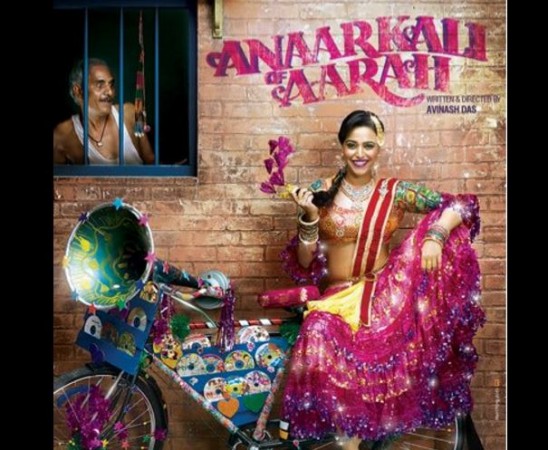
Our heroine in this film, Swara Bhaskar, is a dancer in a small town in Bihar. She is popular and famous within her town, she performs at weddings and college functions in front of audiences in the hundreds. And by doing that, she makes enough money to support herself and her small troupe of back up singer/dancers and musicians. When she is performing, she is Anarkali of Aarah. She wears spangled dresses and elaborate hair and make-up, she speaks in double entendres, and she moves with exaggerated sexual swings of her hips. When she moves through town and in public, she holds this persona like an armor around her. When she is within her house though, she becomes “Anar”. She wears faded simple clothes, squats on the ground to make herself tea, goes to singing rehearsals and jokes with her friends, is a person. A person who is untouched by anything that might be said or done by “Anarkali”, the character she plays on stage.
When she is performing, everyone is supposed to know the rules. Watching the numbers in this film, I started to think about the item songs in other movies in a different way. In an item song within a film, we see a dancing girl (or a Tawaif in the period films or a cabaret dancer in the older films) and we see the hero watching her or dancing with her. But never touching her. Never interrupting her routine. Always letting her take the lead as to when she is ready and willing to dance with the audience and how far she is willing to go. And in a way, those item songs could be considered instructional videos. If you are one of these Bihari university students seeing a dancing girl for real life for the first time when Swara comes out in her “Anarkali” persona, then you know what to do. You cheer, you applaud, you whistle. You do not storm the stage, you do not try to touch her, you let her decide what will and will not happen.
This movie is about what happens when someone breaks the rules. Sanjay Mishra, a local politician, is obsessed with Swara. He does not understand that “Anarkali” is just who she plays on stage, not the real person, and that he has no right to the real person. And so during a performance he comes up on stage and molests her, tries to take off her blouse, to kiss her, to put his hand up her skirt, until she slaps him and runs away. His sin is not in what he does exactly, it is that he broke the rules, her rules. And maybe they don’t make sense to anyone else (even she herself has a comment about how if this had happened at a private performance instead of in front of 100s of people, it would have been different), but they are her rules and they were clearly indicated and he broke them anyway. That is what was wrong, he broke her rules.
Swara through out this film lives her life by her own firm rules, and that is what keeps her sane and safe. She is so confident in her own sense of proper and not proper that she convinces those around her to follow those same rules without needing to spell them out. And the miracle is, they do follow and understand them. She performs with her troupe in front of 100s of men and is in no danger. She lives in an unlocked house and no one in the neighborhood dares enter without permission. She has a sexual relationship with her manager/hype man but it is only on her terms and with her permission. Her weakness comes when people around her try to make her doubt herself.
After Swara is molested, she goes to file a police report and the police do not accept her premise that she was molested, do not believe in her rules. Sanjay Mishra sends men to her who also do not believe in her rules and insist she must come with them to have lunch with Sanjay and accept his apology. And finally her own manager Pankaj Tripathi insists on taking her to meet Sanjay, he no longer believes in her rules either, thinks that sex with Pankaj is something he can decide for her, not that she can decide for herself. Until there is a complete breakdown of her world not with a rape (as it would be in a simpler darker movie), but with the police framing her for prostitution by hiding a man in her house. The one big unbreakable rule of her life is that outside of the house she is “Anarkali”, but inside she is “Anar”. We see that transition over and over again, most strikingly when a young man Mayur More follows her through town and she invites him in, revealing her “real” self and watching his reaction before inviting him to join her troupe of musicians. Once her house has been desecrated, first by the police and second by the neighbors who came in and destroyed it afterward, there is nothing left for her in this town, the protection of “Anarkali” is gone and all that is left is vulnerable “Anar”.
Swara flees to Delhi with the help of Mayur More. And in Delhi, he wants to protect her, he thinks the best way to do that is to lock her away in a house, keep her from people. But Swara is dying like that, depressed to the point of physical illness. She cannot be saved by hiding “Anar” away inside a house, she needs to be allowed to build up “Anarkali” again, to create herself anew. And so she starts recording in Delhi, gaining popularity and power again, and finding a way to once again enforce her rules and feel safe.
There is no way to be truly safe so long as “Anar” is endangered back in the village. “Anarkali” may now be safe in Delhi, popular and successful, but she can be brought down and turned back into “Anar” as easily as a reminder of her pending court case and a call from Sanjay Mishra.
Watching the film, it is frustrating to see how no one is really able to help Swara. Her young musician comes closest, he gets her out, he shows her Delhi, he is kind and loving and respectful. But even he isn’t fully able to understand that she doesn’t want a small happy life in Delhi, she wants the life she built for herself which was taken from her. And because no one can understand what she wants, even the most well-intentioned of them, it is up to her to once again throw herself in front of danger and pull out her own success.
There’s a reason our heroine’s name is “Anarkali”. In Mughal-E-Azam, everyone dismissed Anarkali, even Prince Salim who was supposed to love her. She was merely a dancing girl, they expected her to be faithless, easy to convince away from her love. Anarkali is generally a weak character, one who follows Salim rather than thinking for herself, who is ruled by her love. But she has one moment of great strength, when she is brought in front of Akbar and Salim to dance and instead of dancing to please them, dances to please herself. She declares her own power, her own identity, her own desires, takes the little space that is hers in the world (the dancing floor) and uses it like a weapon.
That is what Swara does in this film. There is a strange blindspot in the functions of power, they give performers (especially female performers) a stage to entertain. But they forget that the stage can be turned back against them. And so Swara turns the tables on Sanjay, agrees to perform for him and then uses her platform to humiliate him, play the video of his molestation and sing out her anger in a place where no one can silence her. She restores her own order to the world and gains back her sense of safety.
 dontcallitbollywood
I’m so happy you saw and reviewed this movie.
I also was affraid it will be one of those depressing films about how being a woman sucks and there was a moment (right before she run to Delhi) I was so stressed I almost stopped watching. I’m glad I continued because it’s so good.
Swara created one of a kind character and very hard to forget – her attitude, dance, outfits, make-up it stayed with me weeks after I had seen the movie. I also become a fan of Pankaj thanks to his role. He was so oddly sexy.
And can we talk about the music? One of my favourite soundtracks from last 5 years.
LikeLike
The music is great! And authentic sounding, I could believe these were songs a team of village musicians could write and perform. Just like Swara’s dancing was believable, not trained and perfect but fun and energetic and something a village woman could teach herself.
LikeLike
I was obsessed with the music and have been listening to the songs almost everyday for months. Now I was clean, but the moment I started reading your review Dunaliya Mein Jung started playing in my head and now I’m here, one hour later still listening to the soundtrack.
LikeLike
I am so not-classy, I have to admit I missed the modern electronic sounds.
On Tue, Aug 27, 2019 at 5:12 PM dontcallitbollywood wrote:
>
LikeLike
Ha ha I think those songs are everything but classy (when it comes to the lyrics of course)
LikeLike
This is a beautiful movie with such raw performances that it almost feels like a documentary. And it’s so universal, what woman hasn’t felt the fear of possible male danger, and hasn’t either edited her choices to feel safer or challenged the fear while feeling challenged by the risks? This is really every woman’s story. And to your point in your write-up, you really get a sense of the entrepreneurship of a journeyman dancer.
How come we haven’t heard from swara lately, since VdW? Anything coming up on her plate soon?
LikeLike
Looks like Swara has a webseries on “Voot”, a platform I have never even heard of.
And agree about the universality! I’m not a sexy dancer or anything, but I’ve, I don’t know, ridden the El alone after 10 o’clock at night. It’s a little scary and a little exciting, but more importantly I got to do the thing I wanted to do even though it meant I was feeling a little bit scared later. The fear was worth the risk. I got to see Ra.One opening night and then had a slightly scary walk back to my apartment and it was worth it.
LikeLike