
I originally wrote this back when there was a little group of us all plowing through right after it was added to Netflix. Not sure if anyone knew has seen the show since then, but maybe the same old folks have had new thoughts. Or maybe this will inspire someone new to check it out.
I had been told many times by many people that what makes Pakistani soaps different (and better) than Indian soaps, or American, is that they are planned in advance for a limited run, the whole story planned out with a beginning middle and end. The other thing I discovered through various articles I read was that Pakistani TV, rather than being the place for people who “aren’t good enough for movies”, is the place for people who are too good for them. The best actors and, more importantly, the best writers all work in television. And finally, I had been told that the reason the Indian audience and the Pakistani audience eats up these shows is that the heroines in particular are allowed to be more outspoken, more powerful, more independent, and more important to the story than they are in any other medium. It is the women that you fall in love with, and the story that feels more like “your story” as a woman trying to make it in the world than anything you can find anywhere else.

(Mahira Khan, who is definitely the most important person in this story, not her husband and co-lead)
Some of this is the same as the appeal of soap operas worldwide. They are havens for female storytelling. Based on relationships, family, the home. With strong heroines who survive against all odds, and men who just stand there and look pretty. But often these soaps keep the heroine too tied to the home, making it appear that she has no other way of interacting with the world. They may also make her a little too enduring, as though the female ideal is someone who will passively succumb to every situation. And, as the episodes crank on and on, they can also make her seem like someone who is a bit too dramatic, too quick to fall in love over and over again, too willing to believe villains and get herself into dangerous situations, and so on and so on.
But, Humsafar, this is something different! It reminds me most of all of BBC miniseries. Downton Abbey, Upstairs Downstairs, and the many many versions of classic novels. Great story that was planned start to finish, great cast, and most of all great characters, characters who are “evil” and “good”, of course, that is a staple of soap operas, but who also have understandable motivations and feelings and react like real human beings to situations, not like machines for drama production.
Okay, that’s all the stuff for people wondering if they should actually watch this show, time to get into the first 8 episodes and SPOILERS SPOILERS SPOILERS SPOILERS
The show starts sloooooooooooow. I watched, or half watched, about 3 and a half episodes and it just wasn’t drawing me in. But then in episode 4, suddenly things start clicking along. And then it slowed down slightly again around 8 and 9, picked up again, slowed at 13 and 14, and so on.
This is just the pacing for the show, it wants to take the time to let us fully understand the characters and what they are going through before kicking the situation into gear. And with a set plan of 23 episodes, there are multiple situations it has to start, end, and then restart.
The first episode is focused on making sure we understand all of the family relationships and situation. Ashar (Fawad Khan) is rich and lives in Karachi with his mother Fareeda and his father Baseerat. Khirad (Mahira Khan) is middle-class and lives in Hyderabad (NOT the Indian city as I originally thought, but a city in Pakistan with the same name) with her widowed mother Maimoona. Maimoona is Baseerat’s sister, but they have grown apart as their lives became so different in adulthood. Khirad is frustrated with her uncle and the way her mother always defends him, saying that the two of them can survive fine without him and there is no need to call him and try to maintain the relationship.
Meanwhile, Fareeda is also frustrated with this closeness, worried that Maimoona will someday ask Baseerat for something which Fareeda doesn’t want him to give. From the start, the two women are set up as opposites to each other. Khirad so proud that she doesn’t want to take anything from anyone. Fareeda is so proud that she doesn’t want to give anything to anyone. And both of them are frustrated by this relationship between brother and sister which promises to turn into charity at some point.
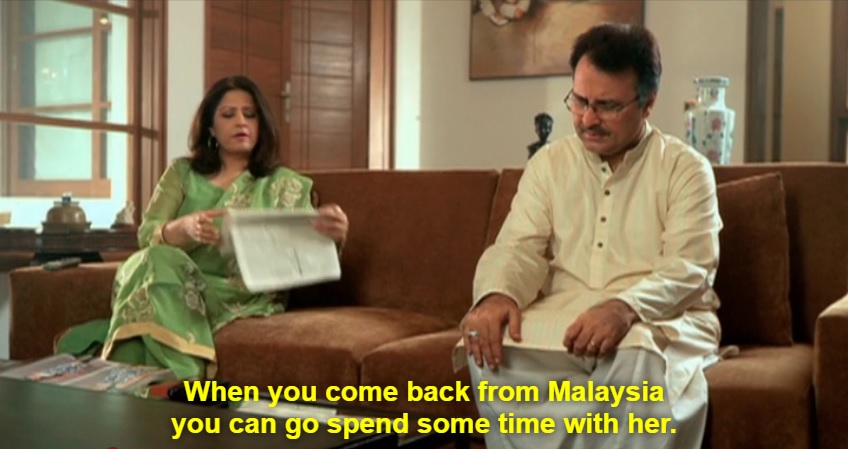

(See how they both have doubt faces about this brother-sister relationship?)
But both women are powerless. At this point, it is a story between brother and sister. Maimoona discovers she is ill and decides to call her brother for help without consulting with her daughter. Baseerat decides to immediately travel and bring his sister and niece back to his house without consulting with his wife. And then, when Maimoona expresses concerns over her daughter’s future, Baseerat decides to marry Khirad to his son Ashar without consulting either child or his wife.
It is in the second episode that the younger generation begins to come into focus. And this was also where the big “different” part of the plot came up, the part that wouldn’t be that different if it were an Indian film, that they are being forced into marriage with someone they barely know and with whom they have nothing in common.
I was fascinated with how this part of the story was shown. For one thing, it matches much more closely to my understanding of arranged marriage in the modern age among the upper educated classes. It’s not “daughter, I declare you shall marry this man!”, but rather “daughter, what do you think, would you like to marry this man? If not, tell me, no problem, we will find someone else.” More often it isn’t an arrangement between strangers brought together by their families, but between long term acquaintances who seem compatible and get along well. And if it is between strangers, they are giving loads of time to get to know each other and get along during the engagement period.
But you don’t see this version as much in Indian films. The arranged engagement is an impediment on the course of true love, it is something your evil father is forcing on you. Or, alternatively, it is the exciting start of true love, the first meeting, the first night, etc. etc. Really, what we get here! Only in Indian films, this version is treated as normal and expected. Whereas in this serial, the idea of two strangers marrying is (more accurately) treated as exciting and unusual among this class.
(This is essentially the same as what we get in Humsafar, only the marriage didn’t have any elaborate explanation for why it had to be so sudden or between strangers, that’s just how things worked out. Society wasn’t that fascinated with it as a curiosity)
Baseerat has offered his son in marriage to his niece, but he still asks his son to agree to this. In the same way, Maimoona is touched by the offer and delighted at the thought, but asks permission from her daughter as well. The older generation fully supports this idea, but it is taken as a matter of course that nothing can happen without the agreement of the younger generation.
And, although it wasn’t immediately apparent, this decision on the part of the older generation is the ending and resolution of the brother-sister conflict which started the show. Baseerat has ended his guilt over the distance he made between himself and his sister by spontaneously offering the best thing he can give her. And Maimoona has found comfort in death and confirmation of her view of the world through her brother’s kindness. Done, finished, no more emotional depth or progress to be earned from them! Time to move on.
And so in episode 2 we begin to learn more and more about Fawad and the forces around him. Fawad is a nice decent young man who cares for his father and mother. His small dream for his life was to marry a woman that could be a true companion to him, that could share in his interests, his struggles, his life completely. I may be reading a bit much into this, but it reminds me a little of Elizabeth Bennet and her parents. Pride and Prejudice starts with a blunt and hard look at the failure of Elizabeth’s parents’ marriage. It takes Elizabeth herself pages and pages and pages to finally admit that her family is less than perfect and her parents’ marriage has problems. But, if you choose to interpret it that way, you can see in the way Elizabeth and Jane both approach marriage a sense of caution and care that might be a reflection of their fears coming from observing how a poor marriage, not a disastrous one but a poor one, can forever affect one’s life. Is it possible that the slight strains and tensions we are seeing between Fawad’s parents are the reason that he dreams of a different kind of marriage, one between compatible equals?
(BBC gets it. That’s why we end with a wedding ceremony in which all the failed or flawed couples are gathered around to watch)
Because Ashar dreams of this kind of marriage, he is blind to the plans that are already in motion to marry him off. Not to Khirad but to Sara, his maternal cousin. Farida his mother, and Zarina his aunt, along with Sara herself, all take this as a given. That naturally the two cousins, life long best friends with everything in common, will make a match. But this isn’t even a consideration for Ashar while he considers his father’s request for him to marry Khirad. He is stunned when Sara confesses her feelings to him, and sympathetic to her as his friend, but clear that such an idea never occurred to him and he has no particular desire to marry her or return her feelings now that she has brought it up. No, Ashar’s internal debate is only between whether he can give up his little dreams for a different kind of marriage in order to please his father by marrying this woman he doesn’t know.
Khirad’s debate is also internal and against herself. She resists taking a marriage in charity, giving up her pride and living forever as a grateful poor relation in this household. Especially as she has overheard Ashar talking to a friend and knows he is resistant to marrying someone so different from himself.
These essential conflicts are what will arise again and again between them. Ashar feels that he is married to a stranger, he is never sure what she will do or think in a particular situation, and is never positive that his view of her is correct. And Khirad never feels fully confident in her place, is never willing to defend herself, to speak up on her own behalf, because she feels she has no right to do so.
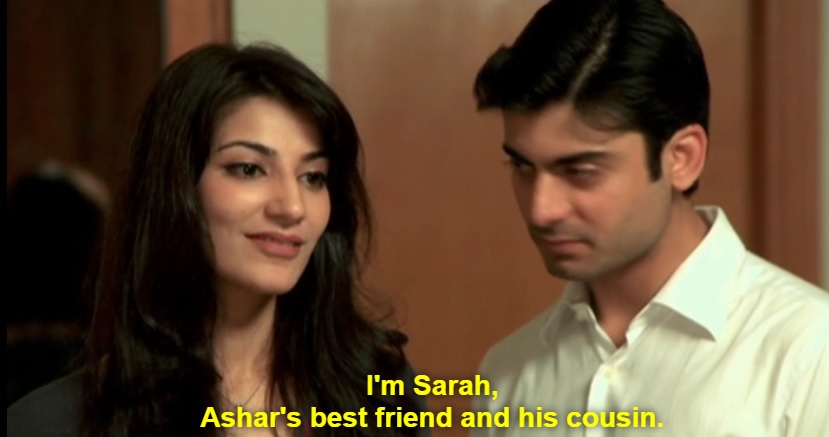
The 3rd young person to spring to life and focus in this episode is Sara, Khirad’s cousin. She is a different kind of personality and person than Khirad, an interesting contrast if this is what Ashar is used to from the woman he knows best. She is seemingly straight-forward, blunt even. She confidently tells Ashar what she wants from him, if it is attending a party together or meeting for coffee or anything else. She is never hesitant or shy, she is always happy to take the lead in their conversations. And, of course, she is also dressed in modern clothing, a career woman with blue jeans and knit tops and so on. And, when she confesses her feelings to Ashar, you feel for her. She has spent her life thinking this was understood, that a certain plan would happen. And Ashar has always thought of her as “just a friend”, someone who could take care of herself and had no feelings to hide or which could be hurt.
Although the overall focus of the episode is on the younger generation, it is still the older generation that is actually DOING things. Which is why this particular episode felt so boring to me. All this time getting to care about people who don’t actually turn out to have any effect on the plot. Khirad’s mother tells her to bury her ego and learn to be happy in this marriage, because her mother knows it will be best in the long run. Ashar, rather than confronting his father directly, ends up having his doubts expressed through his mother instead. Baseerat and Farida have a knock down drag out fight in which she insists she is fighting for her son’s happiness and he is being sold off to placate Baseerat’s guilt over his ignoring his sister, and Baseerat doesn’t really address any of her concerns, instead threatening her with divorce if she in any way shows unhappiness with this match. And meanwhile, Ashar is won over at the end, after initially attempting to argue that Khirad could be as happy or even happier with a different groom, especially as he does not want the match, he has to give in when his father begs him simply because this is the match that would make Khirad’s dying mother the happiest.
What I find interesting her is that both the parents and children are correct in this episode. Baseerat really is making an impulsive decision with no consideration of his son’s happiness, only of giving peace of mind to his sister. And Khirad’s mother is miss-reading the household, eager to believe that this relationship will give permanent happiness to her daughter instead of acknowledging the clear flaws in it. And Ashar doesn’t feel the kind of comfort and understanding for his future wife that he should have, and she doesn’t have the confidence in his life and his family that she should.
But, on the other hand, Baseerat is right to have faith in the essential kindness and goodness of his son which will make him an excellent husband once he makes the commitment. And Maimoone is right that her daughter can find great happiness in this household if she learns to set aside her pride and open herself up to it.
But, still, boring! Interesting, sure, coming to understand all these dynamics and different people, but let’s have something happen already!!!
And then in episode 3, EVERYTHING HAPPENS!!!! And nothing. At least, nothing in terms of the relationship development. Just a bunch of big events to move things forward. Sara tries to kill herself after learning that the engagement was confirmed and Ashar agreed. While Ashar is in the hospital with her, he gets a call that his aunt is dying and has to rush home and marry Khirad immediately so her mother can witness it. And before Ashar can really process all of this stuff that has suddenly been thrown at him, his aunt dies too.
I guess the only relationship movement in this episode is that EVERYTHING HAPPENS all at once which kind of makes all of the relationships have no time to fully reset themselves. Khirad has no time to think about her marriage to this stranger, and Ashar has no time to think about this revelation that his best friend is suicidally in love with him. Worst of all, he has no time to talk with Sara about her actions, to learn that they came about through confidence she was given by his mother and aunt that some day they would be together. And to clarify once and for all that he is sad for her as a friend, but does not feel this way about her. The line that stuck with me particularly is when he was in the midst of explaining how sorry he was for how upset she felt over his marriage and said “I wish I could marry you.” Definitely something you need to explain a little further! Add on “because I realize that you are willing to kill yourself over this and I don’t want to cause your death, not because I actually feel anything like that for you.”
(Notice how Shahrukh is superior to Fawad in this way, being careful to never promise Karisma any more than he can reasonably give)
And then we enter episode 4 and it all slows down and hits into the track it will keep on for the next 5 episodes. Khirad and Ashar are married, but still strangers. Ashar’s parents have made up, Baseerat apologized for his threat and asked for his wife help in welcoming their new daughter-in-law in her new position. And Sara is home from the hospital and delightfully wonderfully NUTS. No more kind of boring conversations in coffee shops to help explain relationships, instead it’s a lot of secret eye rolls and evil smiles and eyebrow raises and so on. And, of course, she has sworn to break up the marriage.
And now we hit a nice rhythm. For episode 4-8, the lines are clearly drawn. Sara is trying to break up Khirad and Ashar. Farida and Baseerat are trying to make Khirad feel more at home in their home. And Ashar ping pongs between the two. While Khirad is caught up entirely with her grief and later with her husband.
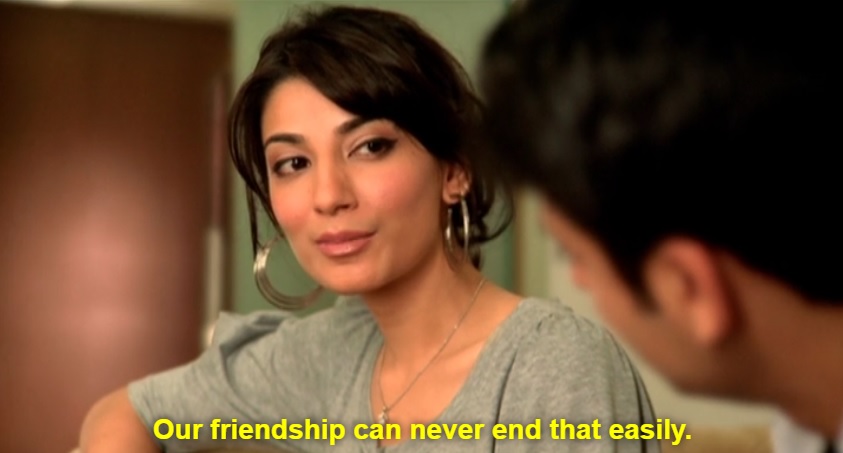
At first Sara appears to be winning, encouraging Ashar to come out drinking with her, getting him to admit his disappointment in his marriage and his wife. These scenes must have been such a treat for the actress, she is saying all the right things, but in such a way to undermine Ashar’s confidence in his marriage. And she gets to give these great eeeeeeeeeevil reaction shots to the camera. But they also kind of make Ashar look weak, that he is falling for this, that he has so quickly forgotten her professed love for him, that he has so little sympathy for his new wife.
But then, on the other hand, once he finally does straighten up and fly right starting with the end of episode 4, it is so much more powerful because he isn’t just being a good son and blindly following what his parents tell him to do. It feels like he worked through some stuff and kind of got there on his own a little.
Khirad, on the other hand, remains a bit of an enigma as to how she came to care for her husband. Well, Fawad is super cute, I am sure that is part of it. But she is such a quiet woman, when he flirts and compliments, she can only look down and murmur that she is nervous. This is what intrigues him, that she is so different from the other women he has known. That he can never be quite sure where he is with her. While Khirad struggles to accept all the kindness she is being given, to trust it and to believe that she deserves it.
I love how Khirad’s character is drawn with this struggle. It’s not that she has low self-esteem and doesn’t believe in herself, it’s that she believes in herself too much. She has always worked hard and proved herself on her own. Our introduction to her back in the first episode was dusting their small apartment and helping her mother give tuitions to earn money. A woman who has always worked and made her own way would naturally feel unsure when suddenly her only responsibility is to get ice cream with her father-in-law and bring tea to her mother-in-law. And what can she give her husband in return for all the love and support he has given her?
In the first 3 episodes, Khirad and Ashar had almost no scenes together. But in the next 5, almost all of Khirad’s scenes are with Ashar alone. Partly because HE’S SWOONY, and their love scenes are the best! But also to make the audience feel how completely he has become her world. She lives for when he comes home at night, when he drives her to school in the morning, when he surprises her at lunch time. Later episodes talk about how she doesn’t even eat unless he is there, and it doesn’t feel surprising based on what we have seen already.
Their bond grows and grows slowly over the episodes, as we see how Ashar has become completely besotted with his new wife, delighting in every new discovery he makes about her, from how beautiful she looks in party clothes, to how easily she interacts with his friends, to her educational background (gifted in maths!) to her belief in honesty when she shamefully admits her culpability in a small household matter. But Khirad, meanwhile, is still cautious in how much she admits her feelings, at this point the showrunners suddenly introduce an old friend to talk with her and an email voice over technique because otherwise we would have no idea what she was thinking. And we learn that her focus is on improving herself, making herself “worthy” of her new higher class husband, she she feels she has earned his love. And, possibly, this explains why she has not expressed her own feelings, either because she does not feel she is worthy of saying it yet or because she feels she is so lower than him and he so obviously higher that her emotions should be obvious.
And now we enter a new phase. Episode 8, Khirad is calling Farida “Mummy”, Ashar and Khirad are happily sharing a bed and making eyes at each other, Baseerat is delighted with how his plans have worked out. But then two changes happen. First, with Ashar’s encouragement, Khirad signs up for the advanced studies she had planned before her mother’s death at the local university. And Baseerat dies. Suddenly, the strongest supporter they had at home has left them and Ashar is adrift. And Khirad’s world is expanding outside of her husband.
 dontcallitbollywood