
I really liked this movie. No duh, of course I liked this movie, it’s a Zoya Akhtar film! I like everything she does, always. And of course, she found the PERFECT way to bring out The Archies, in India.
Whole plot in one paragraph:
Riverdale is a small hill station founded by Anglo-Indian families during colonialism. It has continued through the generations to 1964 when the first post-Independence group of teens are living there. Khushi Kapoor is Betty, daughter of the local bookstore owner. Suhana Khan is Veronica, daughter of the wealthy Lodge family who frequently leave town for long vacations. Agastya Nanda is Archie, son of the local travel agent who dreams of moving to England and being a rock star. Vedang Raina is Reggie, son of the local newspaper owner. Mihir Ahuja is Archie’s best friend who tries to give him advice. Dot is Ethel, the talented young hair dresser in town. Yuvraj Menda is Dilton, the smart one. The Lodges return to Riverdale after months away and Mr. and Mrs. Lodge plan to tear down the town plaza, and build in the center of the town park. Meanwhile, Veronica and Archie pick up their casual dating relationship where they left it, and Betty and Veronica are best friends again. Archie two times Betty and Veronica, they find out and tell him he isn’t good enough for either of them and their friendship comes first. Dilton has a massive crush on Reggie and can’t bring himself to say it, but Reggie tells him he knows, and it’s okay, and don’t be afraid even though Reggie doesn’t feel the same way. But bubbling under the surface of all of this is the question of the future of the town, and the community. Are the adults committed to saving the park, the traditions? Or are they tempted by money and success? Or, more common, by how easy it would be to just leave? In the end, the kids pull together to have a protest and a festival and gather enough signatures to save the park, Veronica chooses her friends over her family, and it ends happily.

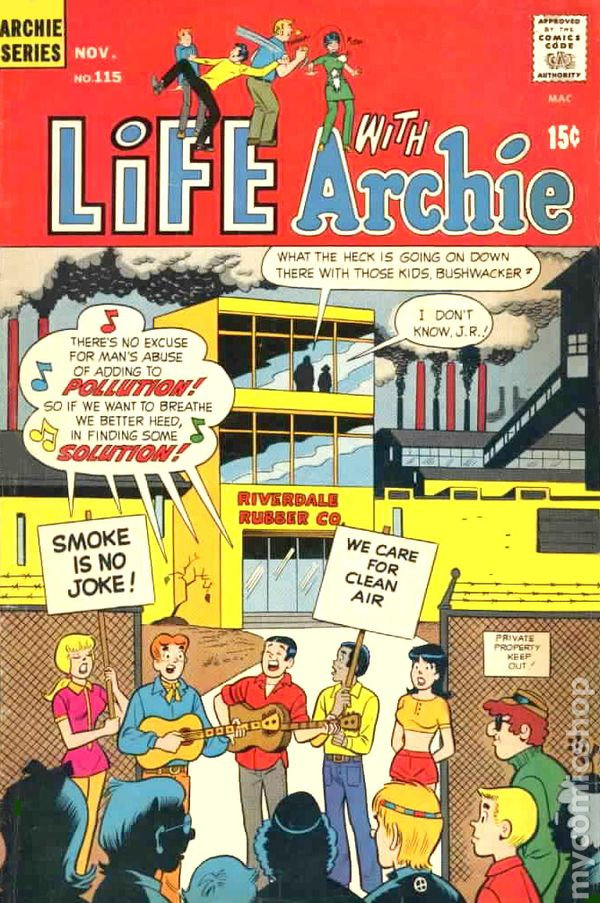
I loved The Archie comics growing up, and what I loved about them is how cozy they are. It’s the same people in the same places over and over again, every day. The Archies originally became popular in the 1940s, when for the first time “teenage” became a thing in America. Before that, you were a child, and then you were an adult, there wasn’t this concept of the magical in between time. Not to say it didn’t exist for a lot of people, it just wasn’t packaged and promoted and talked about the way it became in the 1940s. Teenage clothes, teenage music, teenage movies, everything just for them. And it is this magical bubble, where you have your own life and friends and culture, but you are still safe within your parents home too, you don’t have to go out in the world just yet and risk things. As a child, this is the Dream. You don’t want to really grow up, that sounds terrifying. But being able to do all the grown up things, while still living with your parents? Heaven!
Part of the Grown Up Things is dealing with real life problems. That’s always been a through line in The Archies. The kids came together to protest, to support, to do all kinds of things. Just hanging out at the beach and the shake shop is no fun if you don’t also engage with bigger issues.
Obviously, this is why Archie comics are so popular in India, and other places globally. The idea of being grown-up-but-not-quite is delightful, who wouldn’t want that? But Archie comics are also very firmly and specifically within a certain place, within American/Western teenage world. Why do the children of India feel so comfortable reading books with everyone in western clothes, speaking English, talking about Christmas, and so on?
And I think that is the question Zoya asked herself, and the answer is this movie. The Anglo-Indian community, and their influence on Indian culture, is something that’s not really talked about. But the evidence is there, in Christmas, in Archie Comics, in rock n’ roll, in all kinds of things. And yes, there are places like “Riverdale” in this film, little bubbles where that very specific community thrives. Archie Comics are always about protecting Riverdale, how much more important would that be if Riverdale is also the refuge, the special place where these kids can be at home?
This film is distinctly an Archie Comic story, you have the love triangle, the practical jokes, the school dances, and so on. And you have the protest storyline which is serious, but not TOO serious (it’s just about saving their local park, not anti-war or something). And it is also making a statement just by saying “This is the community where an Indian version of Archie Comics would take place, this community exists, we are influenced by it every day and yet we never quite look at it.”
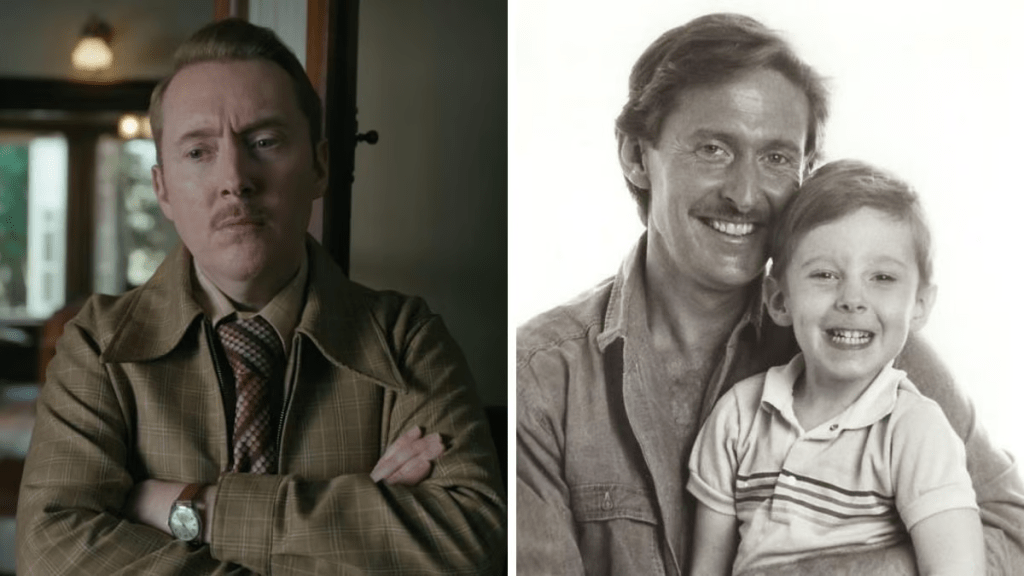
There is one key role, the honest town clerk, that is played by a known Anglo-Indian, Tom Alter’s son Jamie. Tom was the grandchild of missionaries, both his parents had been born in India, and then he was born in India. And he happened to be blue eyed and blonde and white skinned. Tom was beloved in the film community, and by the public. He spoke better Hindi than anyone, was tall and handsome, and Indian. Indian in every possible way, by birth, by career, by experience, everything. And his son Jamie has continued that tradition, working as a journalist and sports commentator and not bothering to be anything but himself. So it is lovely to see him in this movie playing a character that is an Indian town clerk who just happens to look fully white.
It’s not just Jamie Alter, in every crowd scene in this film you see white people, and no one raises an eyebrow, no one asks for an explanation, everyone just accepts it. There’s lots of other things thrown in for more the high thought side of things, encouraging Archie to stay in India instead of going to England, Betty’s father trying to get kids to read books written by Anglo-Indians, and both Reggie’s father and Archie’s talking to them about what it means to feel a responsibility to their country. But the goal is that a little blonde child can toddle across the lawn in an Indian park and no one will question their right to be there. That’s why we need to read these books, write these newspaper articles, stay in these difficult places.
In reality, the Anglo-Indian community still exists, but is (as always) struggling. It would be so easy to immigrate to England, or Australia, or Canada, or America. And it just gets easier as the years go by. But then who will stay in India for that little blonde child? Who will do the work of reminding people that this community has been here for generations and has a right to stay here?
This is a question for every minority. Yes, it is hard to be a minority. And yes, you have the choice to leave and go somewhere more welcoming. But if you leave, what happens to those who do not have that choice? There is strength in numbers and safety in numbers, you have to stay and fight if you can because you owe it to those who can’t. That’s also what Archie Comics is about. Growing up, moving from childhood to adult, makes you realize the power you now have. And the responsibility of that power. In The Archies, the kids are too young to vote, so their opinions don’t “count”. But they are old enough to ask others to vote, and fearless enough, and they have nothing to lose (unlike their parents who are worried about jobs and stability and all those other things). That’s universal, in all Archie stories, the things that only teenagers can do. It’s parties and fun times and flirting, and it’s also standing up to authority and speaking truth to power.
 dontcallitbollywood
I have been waiting for your review. I really liked this film. Though I was not an avid Archie reader in my youth, I found the story in the film to be very good, the filming was well done, and the acting well done. The music and lyrics were perfect.
Some of the scenes were lovely – Betty & Veronica dissing Archie; Betty’s father the story teller; even the end where Mr Lodge said “win some/lose some”.
In all it was a fun and entertaining experience.
Your comments about diversity were quite poignant.
LikeLiked by 1 person
I wanted to love this movie so much, but I thought it was so dull and meh. Maybe the fact that I never read the comics was a big factor. I was so excited about the film based on the promotional content, but then I was so surprised that I had absolutely no emotional investment in this at all as I was watching it. I found almost all of the performances just dreary, like the whole cast were on downers. A review I heard, probably Sucharita’s, said that some of the performances were surprisingly “lethargic.” When I think of Zoya’s characters they are always so fully realized and they weren’t here at all. I did a few moments here and there, especially Reggie and Dilty’s sweet moment and the two of them were by far the standout in the acting department. I found the three main leads average, but on the positive side, so were the three leads in Student of the Year until they were challenged in later films. The production design, the music, and the costumes were the only worthwhile elements of this for me, so still a 3 out of 5 for effort.
~filmilibrarian
LikeLiked by 1 person
Agree, I tried watching it without the watchalong and fell asleep. 😂
LikeLike
I like this review more than the film. ❤️🥰
LikeLiked by 1 person
I wish I could love the movie as much as you but unfortunately it just didn’t do it. I do wish that rather than an exclusively anglo indian town, they sort of integrated some characters as anglo indians and others as indians. It would’ve been interesting to see that angle between the relationships and also the changing dynamics. Sort of like Dil Dhadakne Do, with the power imbalance but here with race.
LikeLike
I’m grateful for a lot of things about this blog, not least of them is the watchalong we did this Sunday. I honestly came to this film like a blank slate – no expectations, just some fun watch times with friends, knowing that whether the film was good or not – it would still be a great experience discussing it. I really didn’t expect to feel the way I do about this film.
I finished a re-watch of it yesterday, and have been trying to collect my thoughts today. There was plenty I missed in trying to watch AND comment here, so I wanted my re-watch to be one where I gave my undivided attention, because I know Zoya Akhtar and Reema Kagti as directors tend to slip in the smallest details that only add up to something when you’ve seen the full story.
So here are some of my re-watch notes!
1. One thing that struck whole we were all discussing the film, was something Margaret said about this being an intergenerational love story….generations and generations of love marriages culminating in a community that celebrated love. This really got me to watch out more for the parental figures in the movie. They’re not just there to be background material for the younger group – they’re there to ground these children in their history and culture, they are a generation that grew up with their own tastes for music and their own stories and their own concerns and issues – and their reasons for bowing to societal and capitalist pressure isn’t just treated as weakness or cowardice. They were the generation that HEARD Nehru, India’s first Prime Minister, give his first speech in Independent India, in the very park that is at the center of the story. When you look at the year of birth on Archie’s tree (1947), suddenly it makes sense why this story HAD to take place in 1964! The Archies gang in this story is the gang of children that were BORN the year India got its independence, in a community that was still in danger of dying out at the time, mostly through migration.
2. In terms of the parents, two scenes that keep returning to me are the ones involving Micheal, the guy with the Beatles bowl-cut. The kids are bored with his music and find it extremely dated, BUT the elders love it, dance to it, and Micheal even gets his own set of fans at the Founders Ball. You see him again at Fred and Mary’s anniversary party, singing “Plum Pudding” along with Alice before Hal engages in a brawl with him out of misdirected frustration. Both these sequences feature music that is beloved among the elders of the community – the first one shows the gap in interests between the older and younger generations, BUT the sing-along at the anniversary party shows how this simple tradition of doing a singalong that is traditional to the community and in a setting that is personal and intimate…that is something that unites BOTH generations. Similarly, when Archie upstages Micheal at the Ball, he is catering specifically to the crowd he is more familiar (ESP the two girls). But at the park, he is singing something that will appeal to his entire community, in the hope that it will save the park that is *their* collective history.
3. I also remembered Hal’s very first scene, where he reads to the young children. The book he reads from is “Horton Hears a Who” and the lines are it’s most famous – “a person’s a person, no matter how small”. And it really hits after you go through the entire story once!! Because the biggest obstacle to the kids’ efforts to save the park is that THEIR voices won’t be counted – and they need the adults’ signatures to legitimize saving their joint legacy! And the adults, who SEEM to be the fighters and movers that built and shaped this community post-independence, are so overwhelmed by the red tape and political corruption and backstabbing that they don’t BELIEVE their voices matter anymore! The main song too, “Sunoh”, kinda emphasizes this. I didnt notice this on first watch – but I was struck by the beauty of Sunoh Reprise on my second watch. Not only is it a slower and more serious version of the song, it is ALSO sung in the style of a Christmas Carol! Carollers are unmissable, and you warm up to them out of familiarity and out of love for the carolling tradition, and that’s how the group at least reach a 1000 or so signatures!! Sunoh also explores the idea Hal describes when he reads Horton Hears a Who – “I may be young, I may look like I don’t know much, but I have a voice and that voice matters”.
4. While doing some more research on Anglo Indian communities after watching the Archies, I found that in 2019 an amendment had been made to the Constitution regarding reservations for the community. Much of the discussion that emerged from this move revolved around the community being viewed as miniscule, and the need for representation even today. Within that context, the story of Fred and his brother Ben – their differing choices and how that plays into the decision Archie himself makes to stay in Riverdale – takes on an added poignancy. After reading up on that, the dialogue Fred says to Archie, about needing to stay in their “mulq” because if they don’t stay then how will this community survive…was especially poignant to me.
5. I also loved how they managed to pepper all the specific Anglo Indian references so that it felt authentic to the people in Riverdale but not too overdone. Hal recommending Ruskin Bond…Fred’s and Jones’ colloquialisms that are unique to the community…foods like vindaloo and kulkuls and salted fish pickles being mentioned…and of course a song like Plum Pudding which definitely reminded me of family party singalongs some of my friends would tell me about.
6. It is interesting that the person at the center of the conflict is someone who may have been part of the community in terms of living there, but was probably always at a class-based distance from it, AND stayed in London for a long while before returning… therefore exhibiting an emotional distance too from the land and the community. Perhaps the one thing that ties Hiram and Hermione to the land and community is their daughter, who HAS a deeper connection to it through her friends. Which is why, when their project doesn’t go through, they’re more proud of her win than upset by their loss. I also think a lot about Uncle Ben who DOES represent the members of the community that left India, that see nothing to tie them to the land. But no matter how far they do run, there are remnants of it that they still miss and sometimes crave – Uncle Ben still asks eagerly for kulkuls and salted fish pickles as if he’s a child hankering after a rare treat. The message is clear – Uncle Ben believed that there is no hope for Riverdale, Fred believes in ensuring Riverdale grows. Archie initially wants to follow in Ben’s footsteps, but recognises that “the grass is greener where you water it” – that is, you can’t expect your community to grow and flourish – especially if it’s an already marginalized minority – if you don’t contribute.
7. Last but not the least, the character’s connections with each other!! I feel this was where Zoya and Reema’s familiarity with the source material really shined. I loved seeing Reggie and Dilly’s vibe even beyond their one pivotal scene. I loved that they kept Juggie as aroace-coded coz that was one of the many things about the “Riverdale” TV series that upset me. Betty and Ronnie’s friendship was the personal highlight of the film for me, and I did love that Archie was shown as genuinely confused…like…I want so badly to have a fic where he finds people who are ethically polyam and learns how that works!!
It’s not a perfect film, but I honestly love what they tried to do and at least to me, they succeeded. There was a lot in the film that left me with a lump in my throat and slightly emotional. I wouldn’t mind another re-watch 💖
LikeLiked by 1 person
I love the “grass is greener where you water it!” ❤️🥰
LikeLiked by 1 person
Really interesting point about the Lodges being tied through their daughter! It’s sort of the reverse of the other families. Archie feels like he can move to England, no big deal, while his parents are more tied to the community. The Lodges on the other hand, through their wealth an dprivilage (and Mrs. Lodge being American), feel part of an international community of wealth. But Veronica is just a kid, she needs a community that understands and accepts her particular background, she hasn’t grown into a separate identity beyond her background. OH! And maybe it’s also because she HAS traveled? So Veronica knows that in Europe and America and everywhere else, there isn’t space for an Anglo-Indian teenager. Archie has a vision of England that it will be like Riverdale but better, he doesn’t yet know what he will face there.
LikeLiked by 1 person