
I saw Airlift last night in a packed theater, and it was actually good! But very real and sad and scary. And it’s not playing in that many theaters globally. So, if you can’t find a showtime near you, or if you are too scared to see it (if I’d known what it was like, I would have been!), or if you would just rather read about it than kill 2 hours in a theater, Read On!
(I won’t be able to finish it all in one post, but check back over the next few days, I should have the other bits up soon. Update: part 1 here, part 3 here, bullet points here, and review here)
So many companies produced this thing! The first 5 minutes is just logo after logo after logo. And then, finally, an establishing shot. Kuwait, 1990, big fancy new buildings along a port. Apparently, they filmed in the UAE, and it was worth it. Through out the film, everything looks distinctly different. I would say it actually looks like the middle east, but I’ve never been there, so how would I know? I can say for sure that it doesn’t look like India. Or America or Europe.
After establishing shot, we go into a super fancy room with tacky gold furniture and a bunch of men in flowing robes (apparently, called “thawb”) and Akshay in a fancy suit speaking Arabic. I assume. Again, it’s not Hindi or English, so this is a guess. Akshay is telling a joke, clearly charming them all, and then handshakes all around as they agree that his company gets the deal. One of the men in thawbs comes up to him afterwards, they are clearly good friends and business partners. He is also apparently part of the royal family? The thawb wearer, not Akshay. But, he mentions that Akshay’s friend and fellow Indian businessman in Kuwait will be upset by the way Akshay stole this deal from under his nose. Akshay is a cocky, and doesn’t care.
Akshay leaves the business deal and gets in his car where he speaks Hindi with his driver. This film deals with some interesting things in terms of identity, and the way it handles language is a big part of it. In the normal NRI film, the plot takes place in the Hindi speaking world of immigrants. Our heros will be shown to speak English as a special skill, an ability to pierce the bubble of the immigrant community and reach beyond it. In this film, Hindi is the special skill. Our hero exists in a world of Arabic and English, and Hindi is treated as a magic password that only a special few possess. This scene is the first instance of that, Akshay has had his business meeting in the real world, but is now in the magical out of time and place location of his car, where he and his driver can speak in Hindi.
And as soon as this structure is established, Akshay rejects it. His driver puts in a cassette playing the popular Hindi hit of the day (and gosh darn it, I can’t remember what the song is! Something from Maine Pyar Kiya maybe?) and Akshay orders him to switch to an Arabic cassette, as they are Kuwaitis now, not Indian. In the same way, he tolerates but does not join in his driver’s enthusiasm for taking his daughter back to see India for the first time.
Speaking of rejecting an Indian identity, Franklin the Turtle! Is on the TV being watched by Akshay’s daughter. She is maybe 4? 5? Anyway, old enough to have cute dialogue, but young enough that she can be completely ignored for long stretches of the film. A maid/nanny is trying to feed her, and what’s-her-name from The Lunchbox comes in to tell her it is time for bed. Clearly, she is the mother, and also she is too fancy and sophisticated to dirty her hands with bedtime. That wasn’t an insult, by the way, it doesn’t seem like she is supposed to be a bad mother, just setting her up as similar to Akshay, completely part of Kuwaiti society, more focused on wearing fancy clothes and having perfect make-up, and able to parent through checking in on the child rather than day by day care.

(Franklin! How did you find yourself in this scary scary movie?)
Akshay interrupts the conversation between child, hired caregiver, and supervising parent when he walks in. His daughter runs over and gets a big happy greeting, before (okay, I’m going to look up her actual name) Nimrat Kaur sends her off to bed. As soon as she is gone, the parents start fighting. Now, I’m actually not sure what we are supposed to be getting from this. On the surface, it looks like your standard “corrupted by living outside Indian society, they have lost track of their love for each other” message. Especially since the fight is over whether or not they should go to a big fancy Kuwaiti party that night. But, as you will see, the aftermath doesn’t quite match that.
The most important take away, for me, from this fight is that it serves to define Akshay’s character. When confronted with an angry wife, he refuses to engage, instead showing his irritating through his posture and the bite in his tone, but merely reacting by saying “would you rather fight or party tonight? No answer? Fine, then get dressed, we’re leaving!” He is not a man to lose control, ever, even when angry. And he is not willing to listen to or think about anyone else, even his wife. Not in a cruel way, just that he refuses to see an alternative perspective, or consider anyone’s needs before his own. Just like he did when stealing a business deal from a friend, when rejecting his driver’s attitude towards India, even when sending his daughter off to bed because he thought it was time for her to go.
And, party! And also, song! So, it maybe be a shockingly linear narrative with realism and lowkey acting and all sorts of other unIndian things, but by golly, 20 minutes in comes the first song! Just like clockwork! (And also, if I had been running late to this movie, unlike with Bajirao, I wouldn’t have missed anything important in the first 15 minutes.) Akshay and Nimrat had a back and forth in the middle of their fight about his drinking, and Akshay plays this scene as slightly drunk. Not in a funny way, in a nasty way. He arrives with Nimrat in a fancy room with bellydancers (who are terrrrrrible!) and a band. Nimrat walks across the room and makes pleasant small talk with fellow upperclass women. Akshay weaves in, big grin on his face, big motions with his hands. He goes over to Nimrat, takes her drink, drinks it. She takes it away, he grabs another, and starts singing to her. It’s technically a love song, but it feels more like bullying. Like he wants to party tonight and is not willing to put up with her unwillingness, so he is going to keep grabbing her and dancing and singing until she gives in. It’s not just his wife he is trying to take over, it’s the whole party. While the other male guests are enjoying his dancing, he also grabs the bellydancers, not in a sexual way, but in a way that takes over their performance, and there is a shot of the hired singer, who at first welcomed Akshay’s participation in a duet, sitting on the floor, depressed, letting his microphone dangle as he is no longer needed. So, that shot got a laugh in my theater, and it was well done, but it was also another sign of Akshay’s attitude at this point. This is not a bad man, but this is not a very giving man. He wants what he wants and will force everyone else to go along with it. And, going back to their relationship, it doesn’t feel like they had a big fight and she wants to leave him and he is forcing her to stay although the marriage is dying, it feels like they had a little fight and she just wants to ignore him for a bit, and he can’t bare (bear?) to let her have even that little bit of control over her own life.
Not that anything we have seen so far really matters. It establishes the personality of our hero, but it has no effect on the plot in anyway. And it also doesn’t matter in the grand scheme of things, if Akshay and his wife have a fight, if he wins or loses a business deal, who sings at a party, none of this is life or death. Which the filmmaker wants us to realize because we go directly from the party filled with undercurrents to a dimly lit room identified as a “work camp outside Kuwait”. While the wealthy elite partied, the lowly workers, probably many of them also of Indian heritage, are lying in discomfort in dark crowded rooms. And then there is an explosion and the men, furniture, everything goes flying! We pull back to see the fires burning in the oil fields as, slowly, tanks start crawling over the ridge and onto the screen, then rolling down the highway to Kuwait City. It’s actually one of the most effective evocations of an evasion I have ever seen on film.
And that continues through the next few sequences. The tanks roll in. Helicopters follow. Random shots are fired at buildings, destroying whole floors. People run and screen. That first 20 minutes may not have mattered in the grand scheme of things. But it made Kuwait feel like a real functioning place. And that makes watching it suddenly be turned into a target and a playground for soldiers all the more affecting.
And Akshay is back. His character, already unpleasant, appears down right unlikeable now, when he is woken by a friend calling to let him know about the invasion and his first response is irritation. Well fine then! Next time we’re invaded, I won’t bother telling you! He goes out to the living room to check the TV and the radio, both of which have only static. Nimrat comes out, wondering why he is awake and what is happening. Akshay’s reaction is to downplay it, to tell her everything is fine, that he may want to send her and the daughter to London for a while, but everything is fine. Again, there is a complete refusal to consider anything that is not what he wants it to be. Which is underlined even more, when there is a knock at the door and his driver arrives. Even his own wife is horrified that he would force his driver to leave his home and come out on a day like this. Akshay doesn’t even bother responding to this, obviously he can call on his driver, obviously his driver will come, everything will always work out as he wishes it.
As they drive through the city, for the first time Akshay looks shaken. They see teenage soldiers shooting off guns into the air, grabbing women, his driver has already told him that they are looking for Kuwaitis, and killing them. Finally, they come to a traffic stop, manned by young mustached men. Akshay gets out with his hands up, telling his driver to stay in the car. It feels partly like a protective move, but primarily like him once again insisting on being in complete control. Only, he isn’t in control, this crazy young men with guns are. He starts to try to explain, to say he is Indian, but they grab him and throw him against the car and aren’t listening. His driver comes out anyway, hands in namaste position, begging the soldiers to leave them alone, and they shoot him. It’s just that sudden, no slow motion or big music in the background or deep meaningful sacrifice, just a random killing that they don’t even think about.
Which made me think about 1942: A Love Story. Partly because the visual is so similar, a body in a driver’s uniform with soldiers standing around him. But also because the impact is so similar, and so differently created. In 1942 (skip this bit if you haven’t seen it, lots of spoilers. Or read it! Maybe you like spoilers!), just like in this, the driver serves to help outline the hero through their differences. Our hero is foreign returned, wealthy, romantic, prefers to listen and observe rather than get involved. His driver is a talker, a braggart, with an opinion on everything and an interest in everything. Early on, he brags to the hero that someday he will spit in the eye of the British General if ever they meet, and it gets an indulgent smile, just another of his empty brags. Weeks later, the British have killed his uncle and the entire town is under siege, our “cowardly” driver, still in uniform, having just learned of his uncle’s deaths and the persecution of his aunt afterwards, tries to confront the general and is shot down without a second thought by his guards. He manages to crawl forward far enough to spit at him, as promised, before dying. Our hero, who has had his own series of revelations over the past few weeks, observes this from the crowd and it serves to strengthen his resolve even further as it illustrates the casual unthinking cruelty of the military. It is a moment that illustrates both how heroic the common forgotten man can be, and how it is the responsibility of everyone to protect them.
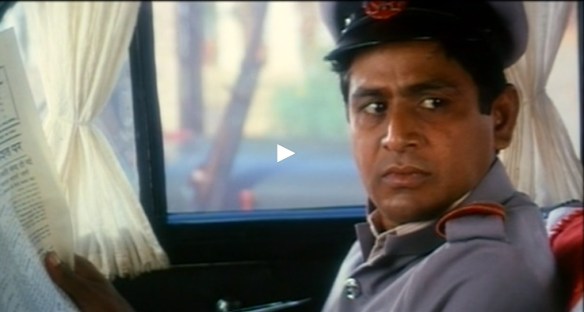
But in 1942, this is a moment long anticipated, going back to one of the driver’s first lines of dialogue, foreshadowed when he left town only to arrive after his uncle’s death. There is a massive crowd, not just our hero, present to witness it. And his death serves a purpose, not just in inspiring vengeance, but because the blood he spilled on the steps becomes part of the ultimate plan to kill the general. In this, the death is as meaningless for the victim as it was for the killer. He wasn’t attempting to make a grand statement, he didn’t care about the men who killed him, he was just there. Both films show war, and how war can cause soldiers to kill without thinking. But in 1942, these deaths are a direct attack and require a direct retribution. In Airlift, they are just meaningless actions that result in grief. I don’t think one film is better than the other, or even more accurate in its depiction of war, but I do think it is interesting how they show the different ways that the same kinds of events can be experienced, and shown on film, depending on the choices of the participants and the filmmakers.
Leaving 1942 for the moment, and going 48 years into the future, let us return to Kuwait in 1990! Akshay is still trying to process what he has just seen, when a figure in the background signals to the men who are holding him and they force him into the car, making him drive while they crowd into the back. One of them puts the cassette into the car radio, and “Ek Do Teen” bursts out. The men start dancing and singing along while Akshay stares ahead and drives.
So much to unpack in this scene! First, Madhuri! Of course. An acknowledgement that “Ek Do Teen” and songs like it were, and are, known through out the middle east. That in many ways the culture of these countries shares more with India than the western countries they prefer to align themselves with. Which is a message that will carry through the film, as we see more and more how the Indian immigrants have been able to find and make a home there.
Second, T-series! As I am sure we all know, T-Series started off as a cassette company. Before India even realized there was a demand for cassette tapes, Gulshan Kumar (to whom this film is dedicated) had already cornered the market. In any other film, this would have been just a nice period appropriate touch, but in this one, the self-referentiality makes my head hurt! Going back to the previous point, even the idea that T-Series is what it is, and has the money to produce a high quality film like this, is built on those international audiences for those cassettes, yes, even including the wild and violent young soldiers shown here.
And finally, how quickly Akshay’s world has been upended. That morning, he was so confident and powerful, he could force his driver to travel across the city at his demand. Now, he is the driver with his passengers determining the music. Oh, and he also does a really good job with his face, keeping it shocked and traumatized even as everyone else in the car dances and celebrates. And of course the real acting challenge, how do you not sing along to “Ek Do Teen”? It’s so catchy! And it’s not like the lyrics would give any challenges!
(So catchy!)
And then there is another 1942 reference! But first, Deewar. Akshay is brought into the same fancy fancy room where he was right at the opening. He is greeted by an older man in a fancy uniform who says “Aaj khush to bahut hoge tum?” Akshay looks convincingly completely confused, while I think “Hey! Deewar! I just wrote about that!” A second after I think it, the fancy uniform guy says it “Deewar! Amitabh Bachchan?” Akshay still looks lost. Akshay!!! Greatest script in Indian history! I am SO ASHAMED of you! And actually, as an audience person, I think we are supposed to be ashamed. That an Iraqi general knows more about the essentials of Indian culture than Akshay does. Again, going back to this different concept of NRIs. Akshay is being given a chance to present a shibboleth which will let him belong with the exclusive club of Indian knowledge, and he cannot provide it. He has disappeared into the world outside of India, rather than remaining within a room in which India is kept inside of the larger world.
Oh, and he’s also still a terribly terribly self-centered person. Turns out, the general knows him from when he organized his security on a previous visit to Iraq. But Akshay, of course, does not remember him. I am kind of sympathetic to both of them here. Like Akshay, I am terrible with names and faces. But, like scary general guy, I have also worked in customer service and bent over backward to help people who never acknowledge it. It ends up working out okay for Akshay, the general so enjoys his position of power over him, that he decides to play with him a little, giving him a magical sticker to put on his car which will give him authority to move freely. He also enjoys showing him, through the window, his business partner from the first scene, hanging from a scaffold.
And we’re back to 1942! The triumphal ending of 1942 is when the evil British General is strung up on the flagpole. It’s the same image, but again, it’s all about perspective. In 1942, we are with the people, and we hate the oppressors. We cheer at his death. In this, we are neither for nor against the dead man. We met him once, briefly, so he is a real person to us, but we know nothing about his actions outside of that meeting. Maybe he deserved to be killed for something we know nothing about. Maybe he was a saint who was killed for his goodness. All we are shown is the shocking fact that a man was alive, and now he is dead. Very different from seeing the whole backstory leading up to it. Really, the biggest difference is that 1942 spends all its time before the battle, before the final deaths, so they have meaning for the audience. Airlift drops us into the battle at the beginning, all that has meaning for us is the pain and fear it causes in the aftermath.
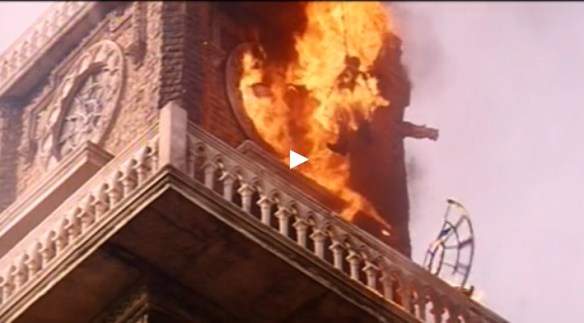
(The end of 1942. You can’t get the full effect without the sound of “Jai Hind” being shouted from the crowd)
Akshay stumbles out of the meeting and over to his car. He leaves the sticker on the dashboard and drives off. He sees more destruction (honestly, I can’t remember exactly what he sees on this drive, there are a lot of these sequences in the film). Soldiers dragging out men and shooting them, looting stores, shooting off guns. He is stopped by another blockade, and scrambles to pull out the sticker, still looking in shock.
He pulls the car up behind a crowd of desis, being kept off by blockades. He fights through the crowd, eventually waving and calling by name to a man in a suit inside who pulls him forward. Which is when we learn through their conversation that this is the Indian embassy, that Akshay has been let in as a powerful man and a personal friend of the ambassador, but they can do no more for him than they can for the crowds outside. In fact, the embassy is shutting down and moving to Baghdad. Akshay protests, asking why India won’t do more for them, and the ambassador points out that the Kuwaiti government disappeared completely as soon as the invasion happened, at least the Indians are still here. Again, Akshay is taught that he has a chance to be part of a larger community, inside of his citizenship community, and he rejected it.
Perhaps because of this, he suddenly remembers his family and calls home. While he is dialing, we cut back to see his family. His daughter is scared and his wife is frustrated. There is a banging on the door. She hesitates, thinking, and it bangs again. Finally she opens it and a bunch of uniformed young men burst in, pushing past and surrounding here. And we are back to Akshay on the phone. It rings and rings and the ambassador tells him that there are tales of soldiers going through the nicer neighborhoods and dragging out woman and killing men. Akshay finally throws the phone down and rushes out, jumping into his car again. Now, the magic sticker is prominently displayed on his front window.
As he drives to his house, he sees people being dragged out of their mansions, women kept to the side while the men are shot. This is the stuff that I thought the little kids shouldn’t be seeing, which would have given me nightmares at that age. Not because it is so violent, but because it is so matter of fact. An Akshay movie where he spin kicks a guys head off, sure! No problem! That’s like watching a cartoon, you know it isn’t real. But seeing soldiers methodically dragging out people and shooting them, that’s something to really fear.
Speaking of fear, Akshay arrives at his house to see the door forced open. He goes through the ransacked rooms, shouting for his wife and daughter. I am preparing myself for a reveal like in Dev. Have you seen Dev? Don’t! It’s very uneven, and philosophically confused, and the best part of it is an incredibly realistic evocation of rape. Which they achieve by never actually showing the rape. You see the two women getting confused on their way home, trapped in the middle of a riot, finally getting cornered in an apartment, screaming, held down. And then, hours later, our heroine’s boyfriend arrives, sees the torn up rooms, glimpses of bodies, and finally finds her, bloodsmeared, with her face twisted up, holding onto a butcher knife with both hands. Anyway, it is a very upsetting sequence is what I am saying. It focuses more on the fear and anticipation, and then the shock and destruction of self after, than on the actual event. And I keep thinking that is what’s going to happen here. That we saw the anticipation and fear in Nimrat and in Akshay, and now we would see him find the aftermath.
But, nope! No one is there. All he finds his a cut up teddy bear of his daughters. He holds it and sobs, and I notice a big slimy line of snot coming out of his nose. On the one hand, a great way to show that after being in control of everything for so long, he is finally losing control. On the other hand, distractingly gross.
And I’m going to stop there for now, four thousand words and about 40 minutes in. I am hoping the next few sections go a little faster, since I won’t be spending as long establishing the basic characters and philosophy.
 dontcallitbollywood
Pingback: Airlift Review (No Spoilers): It Goes from Point A to Point B and Nowhere Else – dontcallitbollywood
Am waiting to go in to see it – there are quite a few small children here. Hope there isn’t much screaming! Will read your summary after I’ve seen it.
LikeLike
Good luck! I hope you enjoy it and I’ll be interested in your thoughts!
LikeLike
Interval.
Good movie so far – moments of tension. Must have been a terrifying experience at the time.
A big audience here. Some small children crying, others playing in the aisles.
LikeLike
Pingback: Airlift Full Summary! Part 2: Details Details Every Where (also, Spoilers, duh) – dontcallitbollywood
Yes, the first 5 minutes or so I was thinking ‘How many logos?’ – fancy animated ones and the static ones
Ranjit – alpha male but not in a good way. Dodgy (maybe) in his business dealings, comes home and gets the kid all revved up just as her mother wants her to get settled down & ready for bedtime, behaves like a dick at parties. Felt like slapping him when he gets the news in the middle of the night about the invasion, tells Amrita that she should leave for London for a few days. She, naturally is a little anxious then he gets all shirty saying ‘what is the matter with you?’ If it were me I would have said to him ‘well, you just bloody told me about an invasion and to leave for London!’
Anyhow the reality of the situation soon hits him and he morphs into alpha-male-in-a-good-way. It takes Amrita longer to understand his intentions and responsibilities but eventually she does and leaps to his defense when George, the serial complainer, complains once too often.
And even George comes to his defense (along with plenty of other able-bodied blokes) later on.
I thought the movie was great, very tense at times but with moments of levity to relieve the tension. Akshay was fantastic. I thought the whole cast was great. One thing did puzzle me, however – when the Iraqi soldiers start shooting people in the streets and looting Amrita & Ranjit’s house – how does Amrita safely get to Ranjit’s business office? A minor point, I’m sure.
Purab Kohli’s Ibrahim was another, quieter, hero of the movie 🙂 (I remember Purab from Gangoobai) . And Mr Kohli from whatever-govt-dept.
It seems that evacuations started within just under 2 weeks of the invasion – https://en.wikipedia.org/wiki/1990_airlift_of_Indians_from_Kuwait – so perhaps the bureaucracy wasn’t quite as snail-paced as portrayed in the movie.
I would say the cinema was 85% full, quite a big crowd for a Sunday afternoon. My son and I were the only non-Desais in the audience.
LikeLike
Interesting! First, that it was 85% on a Sunday! It was packed when I went, but that was opening night, so it’s almost always packed.
It sounds like we were similarly frustrated with Akshay in the first few scenes! I was actually most impressed by his performance there, both that he was willing to play straight up unlikeable, and that he did it so lowkey. He wasn’t like horrible evil bad guy acting, it was just quietly kind of a jerk acting, which is a lot harder to play. And he was still kind of a jerk through out the film, except those same tactics that were used before to strongarm his wife and kid, are now being used to strongarm those in power to get what he wants for his people. It’s actually one of the more complicated and unique characters I’ve seen in Hindi film!
Oh, and I was puzzled by how his wife got away too! I think they wanted the audience to experience the uncertainty with Akshay, but I could have used a sentence in there, after we know she is okay, where she says “It was so scary! Soldiers burst in, but we went out the back and drove to the office while they were taking all the valuables out the front!” Anything to solve the mystery!
LikeLike
I don’t think he was a jerk throughout the whole movie – just pre-invasion/pre-Nair being shot. Then reality hits, he swings into survival mode , initially for himself and his family and then for the wider community. I think that if he had been a jerk after that he would have socked George after the first failed evacuation attempt. But he was just exhausted and resigned to the situation – and Amrita swung into SheWolf mode to defend him. At that point they were on the same team…
Yeah, I think something explaining how she had got way from the house would have helped fill in that gap. I presume she must have had her own car but 2 women and a child travelling together would have been very vulnerable. Perhaps they escaped with a friendly neighbour – we can only speculate.
And something else that occurred to me – we didn’t see much of their nanny once they were at the office – I think I saw her there but not at the camp. Did she have her own family that she joined at the camp?
LikeLike
I guess what I appreciated was that he didn’t have a personality transplant after reality hits. He could have turned into a sacrificing savior working in the kitchens and scrubbing floors, or a huge action hero defending them all, or something like that. But through out the film, he stayed a bold negotiator and confident organizer. His wife even says at one point, that he is always the best at negotiations, and that’s why he has to do all this. It’s just a different way of using the same skill sets which helped him steal the business deal from his friend back in the first scene.
I was also wondering about the Nanny, because I’m also not 100% sure that she was desi? I wasn’t paying close enough attention in her first scene, and then she never really has anything substantive after that. Like his wife’s magical travel from home to office, I think I understand the point they wanted to make, that in the first few scenes they are a wealthy family with servants who are less connected to each other and their daughter, and then at the end they are all eating dinner together instead of him working late while the nanny feeds the daughter and the wife gets dressed for a party. But they had to jettison the nanny to make that work , and it was distracting that they didn’t have just a couple of lines of dialogue explaining it.
LikeLike
Pingback: Baazigar Part 6: Even More Baazigar-y! – dontcallitbollywood
Pingback: Airlift Full Summary, all Plot Spoilers: Part 3 – dontcallitbollywood
It would have been good if Ranjit had grabbed a bucket and a plunger to unblock the toilets when George-serial-complainer had his first whinge, ha ha.
LikeLike
And then he uses the plunger as a weapon and takes out a whole brigade of Iraqi soldiers single-handedly! And then there is a massive dance number.
(maybe I should just re-watch Gabbar is Back)
LikeLike
ROFLMAO!
LikeLiked by 1 person
Ranjit with plunger:
LikeLike
hee hee
LikeLike
Pingback: Airlift: Part 4! The Ending! All the Way to the Finale! Complete! (Spoilers Are Here) – dontcallitbollywood
Pingback: Airlift versus Argo: Does this Even Really Matter? – dontcallitbollywood
Pingback: DDLJ Part 2: Mere Kwabon Mein Jo Aaye!!!! (Oh, and also Spoilers, but you should just pull it up on Netflix and watch it if you haven’t seen it by now) – dontcallitbollywood
Pingback: Ghayal Full Summary! So you can be ready for the sequel! – dontcallitbollywood
Pingback: DDLJ Part 7: Driving, Walking, Finally Communicating – dontcallitbollywood
Pingback: 1st Quarter Box Office: In Stars We Trust – dontcallitbollywood
Pingback: Patiala House: Hey! Is That Hard Kaur? I LOVE Her! | dontcallitbollywood
Pingback: Sultan Part 3 of ?: So Many Songs! | dontcallitbollywood
Pingback: Rustom Review: Akshay is Perfect (NO SPOILERS) | dontcallitbollywood
Pingback: India’s Oscar Entry: Once Again, a Film I Have Never Heard Of | dontcallitbollywood
Pingback: MS Dhoni: The Untold Story (SPOILERS!!!): Review with plot details, Somehow the 1st Half Where “Nothing” Happened Was The Most Interesting Part | dontcallitbollywood
Pingback: Jab Harry Met Sejal Scene By Scene: Part 1, First Song and First Meeting | dontcallitbollywood