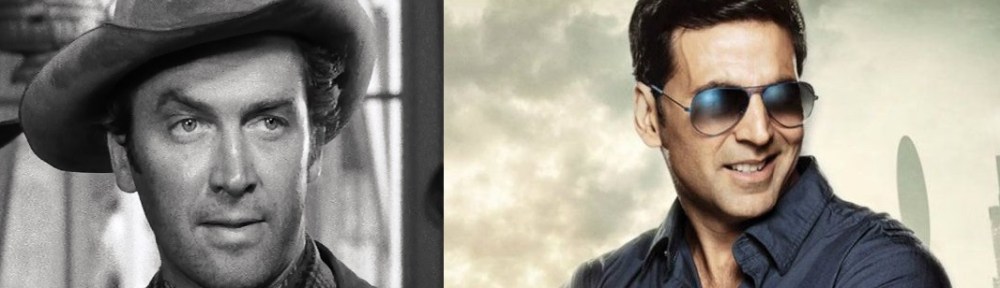
Akshay Kumar and Jimmy Stewart actually have a lot in common! Reliable hard-working long-term popular movie stars who managed to combine a variety of crowd-pleasing roles with some solid acting turns. But what I am talking about today is just economics.
Bollywoodhungama, who I love because they do things like this, pulled together a breakdown of how Akshay did with Airlift. What’s most interesting about this, is that he is beginning to take the Hollywood tack towards profit sharing. This is actually a bad sign for producers, because it takes a much bigger chunk of their profits. And it is also a bad sign for tax-wallahs, because it leads to very creative accounting.
The way it works is, the initial budget for the film is much much lower, since the star lowers their rates to the ground (in this case, Akshay went from a standard 30-40 crore down to 8). But, if the initial budget is lower, that means the film starts making a clear profit much sooner. And if the star gets a guaranteed percentage of that profit, they quickly start taking in more than they would have at a flat rate.
At first glance, it seems like everyone wins here, since if the film makes no profit, the star gets nothing. But, that initial huge salary a star commands isn’t based on a guess. People pay Akshay 30-40 per film, because they know he can basically guarantee an opening of at least that much. So rather than paying him a huge set amount up front and then taking in any profits that come, they are giving him a percentage of their profits, meaning the more the film makes, the more money they lose.
What gets really dangerous, is what Hollywood has started doing as a matter of course, which is to give stars a percentage of the gross, not the net. In that case, it quickly becomes mathematically impossible for a film to ever make a profit. Let’s say the budget is 40 crore and the film makes a 100 crore. And you have promised the star 60% of the box office. Suddenly, you are giving the star 60 crore, leaving only 40 crore to go back to the producers, which is just enough to cover the initial cost. And if the same film makes 200 crore, you are giving the star 120 crore, leaving only 80 crore for the producers, half of which goes back to offset the budget. What has happened in Hollywood, is that this pay rate is standard for most big names, and for the lower names, they get a cut of the net. So in that case, if your film makes 300 crore (because you have a lot of big names). Star A gets 40% of the gross, so 120 crore. Star B gets 20%, so 60 crore. Star C gets 10%, so 30 crore crore. The actual budget was 50 crore. Star D gets 20 percent of the net. Star E gets 10%. And Star F (this is their first film) gets a salary up front and 2% of the gross. But wait! We already spent 260 on the original budget and the gross payouts. So the net is only 40 crore. So Star D gets 8 crore, star E gets 4 crore, and Star F gets their initial salary plus, let’s go ahead and round it up, 1 crore. And then the studio gets 27 crore, and that’s the profit they report to the tax wallahs.
And who started this whole funky accounting system? Jimmy Stewart! That’s right, Jimmy Stewart for the film Winchester ’73. Jimmy and his agent Lew Wasserman worked out the figures, and offered that Jimmy would work for nothing if he could get a cut of the net. And the studio ended up with a much bigger profit than anticipated, since they didn’t have to pay Jimmy’s salary up front, and then Jimmy got to keep a huge amount of that profit. Plus, in America, that counts as capital gains, not salary, so is taxed at a lower level (I don’t know if there is a similar advantage in India or not).
The fact that Jimmy and Akshay are both thinking like this actual makes sense, since they are at similar points in their careers. They are popular enough that they can command a certain set salary for every film and still guarantee the film will make a profit on top of it. So better to take a percentage of that profit, knowing that if you take a loss that on one film you will make it up on the next, than to stick to a salary. Jimmy Stewart actually came up with this idea because he wanted to make Harvey at the same time as Winchester ’73, and he figured the if he made a percentage deal for both, the profit from one would offset the loss from the other. The studio was thinking the same thing, and was excited about avoiding paying him a salary upfront for both at once. And then both ended up being hits, and Jimmy hit the jackpot and Warner Bros. lost big time.
So, why isn’t everyone in India doing this? Well, I suspect they are, it just isn’t being reported as clearly as it was in this case. But more importantly, the really big names (the Khans), are looking at more than just a percentage of the profits, they want the whole thing. There is a reason Aamir, Salman, and Shahrukh all have their own studios now. Basically, they are too expensive for a realistic salary or profit sharing deal. If you are looking at in terms of what they contribute to a films success, they contribute basically everything. So their salary should be at least 100 crore per film (since that is a modest estimate of how much they will add to the box office), or maybe 80% of the gross. Meaning they either have to under-estimate their value when negotiating, or they need to figure out another way to get the money they are owed.
They do low-ball a lot, of course. Aamir especially, he likes to do films that interest him, even if he knows they won’t make enough profit to justify his participation. Talaash, for instance. And Shahrukh has said, with both Jab Tak Hain Jaan and Rab Ne Bana Di Jodi, he didn’t even talk money, but just did the films for the opportunity to work with Adi and Yashji again. I mean, I’m sure they paid him SOMETHING. But it wasn’t the reason he did the film, and it wasn’t as much as he could have made doing something else.
But they have also started producing their own films, so they can get that 100% of the profit they are due. Even though this means they are carrying some of the cost as well, once their salaries are removed from consideration, you end up with a guaranteed massive profit. And no need to split it with anyone else, beyond your fellow producers. Shahrukh in particular is playing this game very well. He has also learned the Hollywood trick of paying back your own studio for services. In Hollywood, this has been raised to an artform, with studio subsidiaries being paid out of the budget for promotion, distribution, etc. Red Chillies hasn’t gone quite that far yet, but if I am reading the credits correctly, I think Shahrukh is paying back to Red Chillies FX for all the work on his movies, which are also being produced by Red Chillies. And for Dilwale, he also started a Red Chillies distribution wing. So that means, if Dilwale made about 350 worldwide, and the official budget was around 100 crore, that is a profit of 250 for Red Chillies that they don’t have to share with distributors. Plus maybe 20 to 40 crore paid to them from the original budget for the FX work. And that isn’t even counting satellite deals etc. etc. So if you are wondering why SRK seems kind of relaxed about it not doing as well as expected, it is because he is probably clearing more on this film, the rights for which he owns outright and which he distributed through his own company and paid his own company for the initial production work, than on any film he released before.
 dontcallitbollywood
Well, Winchester 73 was a fun film . . . .
LikeLike
Pingback: News Round-Up: Salman Makes Big Profit on Sultan, Announces New Heroine for Next Film. And Ritiesh is a Gentlemen. Oh, and Shahrukh’s next role might be AWESOME!!! | dontcallitbollywood
Pingback: Asia Takes Over Forbes (Also, Shahrukh Wins!!!! WOOT To the SRKians!) | dontcallitbollywood
Pingback: Hindi Film 101 Index | dontcallitbollywood
Yay! Thank you for resurfacing this post, right up my alley. The Dilwale comment is fascinating.
LikeLike
Have we talked about the other part of this before? The noblesse oblige paybacks? If the big stars are getting a cut of the net, and if the movie flops, not only did they do all that work for free, it is also expected that they cover the losses of the distributors out of their own pocket. So with something like JHMS, there is no profit so he gets no cut and no payment for his work, plus he has to go into his personal bank account and pay back losses to the distributor. With Dilwale, he is making money left right and center, and also pays back distributors but he has plenty of money to do it. Either way though, it is still expected to happen.
On Wed, Sep 25, 2019 at 10:15 PM dontcallitbollywood wrote:
>
LikeLike
Yes, that is a big share of risk to accept, and it should be acknowledged as part of the story where they get to keep a big share of profits. It makes sense, though, if you think of the responsibility they see for themselves as part of the ecosystem of this cultural industry. The ecosystem depends to some degree on the money they – specifically the dependable money the big stars – bring in. If you had a selfish actor who didn’t help distributors recover from losses, that would have direct downstream effects on whomever suffered financially and lost business, and ripple effects in terms of the risk distributors would be willing to take on in the future. Not only with the stars but with all films, assuming that distributors couldn’t depend on the one dependable piece of their business and therefore had to squeeze more money out of the other pieces. This starts a destructive cycle of everyone trying to protect themselves and grabbing for more money than the business as a whole can sustain. Not enough pie to go around, the system collapses. The stars are like apex predators, if they stop playing their role all the other interconnected relationships and value exchanges get thrown out of whack.
LikeLike
Did you see the interesting discussion we had about the Tamil industry? It sounds like there that is EXACTLY what is happening, a destructive cycle. The stars are the most powerful but allow themselves to be moved back and forth instead of controlling the game. And it is the financiers who end up holding all the cards with no care for the future of the industry, merely destroying all they can and taking as much as they can until (increasingly) nothing is left. There’s no coordination of release dates, no encouragement of new talent, not even any concern with making sure completed films get released instead of languishing until a debt is paid.
And meanwhile in the Hindi industry, the 3 Khans meet and discuss everything from release dates to public statements to promotion tactics to EVERYTHING, all focused on keeping the industry going for the good of all of them. Another part of the Dilwale story, Shahrukh gave an interview months after the release about Bajirao releasing on the same day, and how he spent weeks trying to reach a compromise for the good of both films and the opposite party was completely unwilling to negotiate. That “but this is bad for the industry as a whole!” attitude is what came through to me in Shahrukh’s frustration, that he was talking about trying to give both films a good release and generally keep the industry flowing while the other producers were just focused on their own film, an attitude he had never seen before.
LikeLike
I did read the posts about the Tamil industry and yes, naturally, I’m fascinated. It’s so opaque, though, and farther from what I’m used to, so I don’t feel like I understand very well. But I do agree that there seems to be missing an underlying love of the art form. In all cultural industries there is a balance between art and business, you need the money to support the making of the art and connecting with the audience. But if the whole thing turns too mercenary and isn’t ultimately driven by a belief in the intrinsic human value of what you’re doing, the joy and love of it, it hollows out and the money dries up too. It’s what makes me happy listening to people like SRK and Karan talk shop, Aamir too, what sparked my interest in Rana – they have gotten smart about the money side, but they operate in a way that tries to build up the capacity of the whole system, and underneath it all is this childlike love of making movies. In the Tamil industry, you have skilled and talented people, but the system is failing them, and as a result their voices, the expression of their art, is silenced, it never reaches its audience. That is how it is in most places in the world without well developed cultural industries, the unusual thing here is that the infrastructure is there it’s just broken down. Maybe they’ll have a reckoning of some kind followed by a resurgence. The talent will find a way.
LikeLike
One thing I meant to add: if we’re moving into an era where big Khan movies are no longer reliable moneymakers, I think Karan has done the best job setting up for the future. Salman’s body will break at some point and then his business model will be in trouble. Aamir is more adaptable as a performer and better at picking scripts, but if he himself stops being a big box office draw then the size of his films is going to shrink. SRK has set himself and his family up fine, but what Red Chillies does outside of his big tentpoles doesn’t really fill the gap for the rest of the ecosystem if the tentpoles stop making money. Karan has done the most to try to build into that gap and find new actors and kinds of films that will work across different regions and bring in the younger audience in big numbers. Still could be a tough transition, though, and seems it’s already underway.
LikeLike
But wait, didn’t you get the memo? We have to hate Karan now and call him unoriginal and nepotistic and terrible. Kangana says so.
But more seriously, YES! I agree! And Aditya Chopra also, they have both been focused on nurturing talent and stars both on and offscreen to keep the industry running.
On Fri, Sep 27, 2019 at 2:44 PM dontcallitbollywood wrote:
>
LikeLike