
Do you know what they have in common? Well, not a lot. But there is Indian industry news creeping out which makes me sit up and go “Hey! I just heard this in the American industry about Matt Damon!”
Bollywoodhungama has an article which is supposed to be about Siddharth Anand picking between Deepika and Priyanka for his next film. But that’s not what it’s really about at all. It’s really about something much more interesting (to me).
I don’t follow the American film industry that closely, I don’t know any of the major industrial players or anything like that. But I do read the headlines and follow along the general kind of media news that hits the mainstream press. And there was a story a few months back that was interesting enough to be reported in various non-industrial news sources. And which I have barely enough industrial background in the American industry to understand the importance of.
The big headline for these articles was “Matt Damon in Yellow-Face!” But that’s not what it was about at all. It was about a movie called “The Great Wall“, which is going to be a Hollywood-ish movie made with Chinese money. Which is a Big Big Deal. The Chinese audience is the most rapidly growing audience for Hollywood films. It’s a cash cow for Hollywood studios, it’s the reason they keep making The Avengers and all those other big explosion-y movies that have a tiny profit margin in America (huge record breaking box office, but also huge record breaking budgets, so tiny profit). They just rake in the money in China, at no cost to the studio, because they are usually selling off the international rights anyway. So, actually, the same business model as Indian studios, make the movie, sell the movie to the highest bidder, let them worry about actually promoting it and making money from the box office.
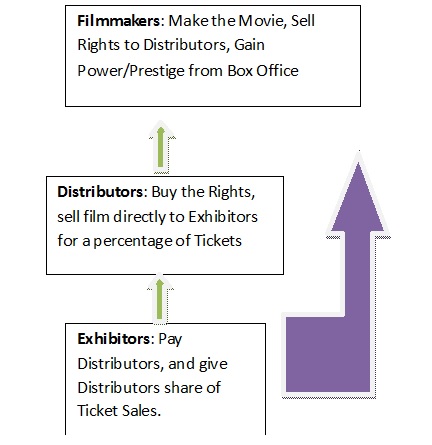
(My graph! So beautiful! Except picture it without the purple arrow, because Hollywood studios get no prestige from the international box office. Because the mainstream American press is dumb and keeps forgetting to take it into account)
Only now the Chinese are moving out of the consumption side and into the production side. It’s kind of like the Tatas (huge news in their family, by the way, Ratan Tata coming out for religious freedom and firing Mistry from running the company) opening up the Taj in competition with the Victoria hotel. The Chinese are tired of just giving their money away to outsiders, they want to have their own product.
So, in Hollywood, the big news was this huge cast, Chinese-American co-production with Chinese and American cast, and Matt Damon is in it. A lot of anger about Matt Damon being the lead in a film set in China, a lot of claiming he was taking a role away from a Chinese or Chinese-American actor. But that’s only if you look at the story from the perspective of Hollywood and Matt Damon. From the China side of things, the story is “we are making our own movie with our own story and our own massive Chinese cast, and oh yeah, we are also bringing in some white guy from Hollywood to front it.”
And in the same way, the story with Dips and Priyanka here is not “Who will win between these two actresses?!?!?”, it’s “China is funding an Indian film and they are bringing in a top director and letting him pick between two top actresses to front it.” Isn’t that interesting? The Chinese market has been divided between India and Hollywood for years (Bajrangi Bhaijaan and Baahubali both did very very well there, and I think Sultan did as well). And now that they have decided to invest money in making their own products, they are splitting investments between Hollywood and India.

(Who couldn’t love this little face? No wonder it did well worldwide!)
Here’s another interesting part of it, from the gender theory side of things. Tubelight is also supposedly funded by Chinese money. So for their first movie, they are doing an Indian actor-Chinese actress. And for their second, according to this new story, it will be a Chinese actor (Deng Chao, I don’t know him, looks like his resume is pretty extensive and the usual combination of wuxia and rom-com stuff) and an Indian actress TBA. Honestly, I have no idea which combo the audience will find more acceptable. I know the Indian audience has a strong preference for Hindu hero-Muslim heroine and/or Indian hero-white heroine. But I don’t know how the whole gender and ethnicity thing will play out when China is in the mix. And I have no idea what the Chinese audience will prefer between the two options.
I wonder if China doesn’t know either? Supposedly it is a 3 film deal with Eros, Tubelight is the first, the Siddharth Anand movie is the second, and the third is yet to be named. Maybe they are trying both gender mix options for the first two and seeing which is more popular before they decide what to do for the 3rd.
 dontcallitbollywood
Fascinating! Yes, especially with all the #OscarsSoWhite, and recent press about East Asian actors having difficulty finding leading parts (@StarringJonCho), there’s been a lot of backlash about Matt Damon being in this Great Wall movie. And the trailer looks bizarre that he’s in it, too.
LikeLike
You know they remade 21 in Hindi with Ben Kingsley and Amitabh Bachchan? I was just thinking about that, related to this story, because it was a time when a Western actor worked in an Asian production as part of an Asian cast, but it got no publicity or protests in the West. I guess because it wasn’t a big enough film (I’m ignoring the obvious “But Ben Kingsley is Indian argument”, because he isn’t really, he is two generations removed from India and is entirely Western trained as an actor)
I mean, if you think of this story from the Ben Kingsley-Katrina Kaif-Tom Alter sort of history of film, instead of from the #OscarSoWhite side, it has a whole different perspective. It’s not about Matt Daman taking a job away using his white man powers, or white-washing of a film, it’s about casting an actor with Western credentials/image in order for the audience to get a global experience. It looks like Andy Lau will be in it too, maybe he is the real hero of the film and Matt Damon is the exotic other brought in for flavor. It all depends on which audience you are considering.
That’s why I find this story from the Indian side so fascinating. Because there is no general global power dynamic between Chinese and South Asian races, they are both considered “other” by the west. And China is doing the exact same thing with these co-productions, bringing in someone from the home industry to work with them behind the scenes (Hollywood screenwriters with a Chinese director on the Matt Damon/Andy Lau movie) and star with their stars. So it’s not about white-washing, necessarily, it’s just about making a global product.
LikeLike
In that sense it’s similar to why Bollywood was so keen on bringing in Pakistani actors lately (leave aside the present controversy). I always wondered why the focus on Pakistani actors and singers, when there were so many qualified people in India dying for a break into Hindi films. Now with all the analyses coming due to the controversy, I finally understood. It’s to attract the Pakistani audience, not the Indian one, and more interestingly, it’s not about attracting the audience who actually live in Pakistan, but the huge Pakistani expat audience in the UK, and possibly the Middle Eastern countries, and to an extent in North America. I say “to an extent” because the North American audience for Hindi movies has been shifting quite a bit over the last 20 years or so, with the major Telugu. Tamil, and now even Malayalam films releasing simultaneously overseas and in India. This has definitely eroded the audience for Hindi films. Because of that erosion, I think the non-Indian but South Asian audience is probably gaining importance in North America, too.
BTW, the first big Indian film hit in China was 3 Idiots, I think. One can understand that, due to the similarly oppressive educational systems in both countries. And wasn’t Chandni Chowk to China also a joint Indo-Chinese production? I think it was.
For your information, China had signed a co-production agreement with the Canadian government a few years ago, too, to fund joint productions, so I think they are basically looking to expand their reach (and possibly control) into all the major film industries in the world. It would be interesting to see if they have similar agreements with the UK industry.
LikeLike
It makes sense, just in terms of language, the Hindi films would do better with Urdu speakers than with Tamil-Telugu-Malayalam, right?
The other thing I wonder, just in terms of soap stars like Fawad, how much the satellite and streaming services have changed things. TV is now international too, and my impression is that the Pakistani soaps are doing really really good with the diaspora, like better than the Indian soaps are with that particular audience, from Pakistan and Indian and everywhere else. So bringing in a soap star isn’t just attracting the Pakistani audience, it’s attracting the massive international audience for his TV shows, an audience that might otherwise be more of a TV audience than a movie audience.
I’ve also heard discussion of the Hindi language abilities being a plus with Pakistani stars. As in, “the Indian stars speak English or some other language first and struggle with Hindi, but the Pakistani stars can speak it perfectly.” I don’t know if that’s true, and I can’t really judge since I don’t speak the language.
LikeLike
The point I was making was that, with the release of South Indian films overseas, too, that audience no longer has to see only Hindi films if they want to see an Indian films. Of course, some of them see both.
On Pakistani actors being better able to speak Hindi, I doubt it. I’m sure they speak better Urdu, and most of the language in Bollywood films nowadays is a mixture of rudimentary Hindi and Urdu, and half English (BTW, I use the term “Bollywood” advisedly here, despite your blog name, to refer to a particular subset of Hindi films, which is actually a majority of them). The funny thing about Bollywood actors is that it’s more important for them to speak English than Hindi. 😦 I read an interview of Tabu’s some time ago, where she was talking about her beginning days in Hindi films, and said something like, “I was just newly arrived from Hyderabad, speaking no English”, which was a big disadvantage for her, despite being related to some stalwarts in the Hindi industry. Note that she spoke both Hindi and Urdu with no problem, but this was not enough.
LikeLike
I read an interesting article a few months back about the problem with scriptwriters and Hindi. Back in the day, like in the 1950s, a lot of it was in classical Urdu poetic stuff. You know, like Sudhir Ludhianvi. And there was this tradition of “dialogue” writers versus screen writers, you would bring in the dialogue guys to do the really fancy complicated Hindi dialogue. My understanding is that is how Salim-Javed worked, Salim did a little more with the plots and Javed did a little more with the poetry and the dialogue. But now, more and more, they are using people who speak English primarily to write the scripts, and the dialogue, and the films are suffering. And even if you use a really good dialogue writer, will the actor be able to deliver the lines?
LikeLike
A lot of the “Hindi” dialogues nowadays are literal translations from the English lines, written by people who are fluent in Hindi but are really comfortable primarily in English, like Farhan Akhtar.
The problem with today’s audience is that they don’t know any language really well. (I’m speaking of the Indian audience for Hindi films). When they released the colorized version of Mughal-E-Azaam, it was a complete flop, not because it was outdated, or a period piece, or slow paced, or what have you, but because nobody could understand the language! And that is a film celebrated for the quality and poetry of its Urdu dialogues.
Similarly, when Jodha Akbar released, I read some articles criticizing the Urdu pronunciation of both Hrithik and Aishwarya (but more so Hrithik’s), but allowing that, for today’s times, it wasn’t bad. And then I read audience reactions of young people who all complained that the language was “too difficult” for them to follow!
And yet when they get American films which are all English, even the educated viewers prefer to watch the Hindi dubbed versions because they say they can’t understand the American actors’ English.
So basically the preferred language for Hindi films these days is Hinglish.
LikeLike
I noticed that watching Jhankaar Beats again recently. I know there was a big deal when it came out, because it was this new kind of movie that wasn’t Hindi or English and so on and so on. But ten years on, all movies sound like that! Even the mainstream releases.
LikeLike
Pakistani serials are beloved by the Hinglish-adjacent urban population in India since Zee Zindagi started them airing them a few years ago. Fawad Khan’s serials have a female-centric subtle Jane Austenesque tone that appeals to a different demographic like Doordarshan serials back in the day than the overwrought Indian dramas with people in ethnic costume.
Caravan did an excellent piece on the launch of Zee Zindagi http://www.caravanmagazine.in/reviews-and-essays/opening-channel
LikeLike
That article is excellent! I really need to read Caravan regularly, everything I have seen from them has been extraordinarily well researched.
LikeLike