Okay, left off at Interval! Going to plough through and get to the end of the film and the surprise mystery twist ending that I totally saw coming a mile away. And then the sincerely emotionally affecting moment that I did not see coming AT ALL! And then the little girl who waved at me on the way out and made me feel all better
Read on to find out everything about everything!
(Part 1 of summary here, regular review here, bullet point version here)
So, I put up a bullet point version of this already (the notes I dashed off as soon as I got home so I wouldn’t forget), and a quick spoiler-less review. And the second half of the recap is now up also, it is here. And now, it is time for me to give a complete detailed summary! For those of you unable, or unwilling, to see it in theaters! Or if you want to see it, but to have my in your head with you whispering opinions the whole time.
I can tell you, without spoilers, that the best part of the whole experience was the truly tiny little girl with an itsy-bitsy little pink coat and bitty-baby pink boots who waved her microscopic little hand at me in the hall on the way out. If possible, try to recreate that when you go.
So, quick review: Catnip for Farhan fans (I know you are out there), Hollywood style/quality camerawork and directing, great songs, script needs a couple more twists to really send it over the top.
Longer review, see below. And I will probably also be posting a synopsis in the next few days, it’s only an hour forty, I can totally knock that out in just one part.
(bullet point version of synopsis, for full film, available here. Part 2 here. Part 3 here. Part 4 here. Final part here.)
Okay, the last section was AMAZING and had the first onscreen meeting of SRKajol, and basically was the high point of the entire movie. But the rest of it is okay too, and they do have a few more scenes coming up as well, plus a song (yes, the header image tells the truth, it is time for “Jaati Hoon Main”), so it is worth reading! And worth my writing it!
(No, that header image isn’t a mistake, read on to find out why)
Oh my goodness, I haven’t even gotten to Kajol yet! I do in this section, and she is WONDERFUL. And, if you find yourself wondering, “was the SRKajol magic there from the beginning?”, the answer is yes, absolutely, from the very first time they shared a frame together.
What do you know, you catch more flies with honey! My loving and detailed and caring summaries of Dilwale got so many more views and (more importantly), were much more fun to write. My painful venom filled hate-watch of Bajirao, not so much! (part 1 here, part 2 here, and the bullet point version here)
So many more notes here than I made for Bajirao! It really is a much deeper film. Or at least faster paced. I’ll be putting up the full and detailed summary over the next few days, but in the meantime, here is a little preview of all that happens in this wonderful wonderful movie.
(also, how proud am I of the pun in my header image? SO PROUD)
(bullet point version of synopsis, for full film, available here. Part 2 here. Part 3 here. Part 4 here. Final part here.)
So, I did part 1 yesterday, and boy was that cathartic! I thought I would hate spending so much time with a movie I disliked, turns out I was able to get all the venom out of my system. Well, most of it, there are still 2 parts to go. So really, just a 3rd of the venom. If you also feel venomous towards this film, or if you really really loved it and want to know why I didn’t, read on! If you loved it and don’t want it ruined, don’t! I am quite nasty.
So, I just finished a 7 part summary of Dilwale, with images, references to film history, star personas, the director’s previous work, the deeper meaning of certain lines and acting choices, and what it all might mean in terms of the careers of the stars. Read it! I had a lot of fun with it!
In contrast, Bajirao, eh. I’m guessing I can knock this thing out in like 3 parts. There just isn’t as much there to talk about. I mean, it’s pretty? If you want just the high points, I already put up a bullet point version of the plot. If you want details, and political-historical-social analysis, keep reading. And if you actually really liked this movie, DO NOT READ. I basically rip it to shreds. And if you haven’t seen the movie, PLEASE READ. If you are like me, you will have a lot more fun reading this than you would watching the picture.
When I say “un-Indian”, I don’t mean morally, or politically, or philosophically (although an argument could probably be made for all those aspects as well). I mean, artistically, this film goes against the 102 year history of Indian film.
So, first, I should say that Bajirao is a very well made film. The script is tight, the camera work is amazing, the costumes, sets, jewelry, hair and make-up are all phenomenal. The acting by all three leads is also really really good. I was confident in Deepika going in (post-Piku, she can do no wrong), but nervous about Priyanka and Ranveer. And they ended up being the ones who impressed me most.
But when I talk about “Indian film”, I mean a very specific technical and stylistic standard, with roots going back thousands of years. And this is not an Indian film.
Everyone in the world is doing “Best of 2015” lists right now. And I get that, it makes sense. But I am incapable of choosing “Bests”! I love all my little movies equally! But what I can do, is remember which movies I watched most in 2015, as it is a quantifiable rather than qualitative decision. So let me count down, 10 to 0.
So, I finished my complete synopsis of Dilwale, but no synopsis can be complete without also discussing, the trailers that set the stage for the film! I saw Dilwale 4 times (so far), and among the various shows, I saw 4 different trailers. For Neerja, Wazir, Fan, and that new Madhavan movie.
So, I’ve been trying and trying to avoid spoilers, or warn people off spoilers, but turns out, you all want spoilers! My spoiler-full posts are getting a lot more readers than my spoiler-free posts. So I will bow to the wishes of the majority and proceed to spoil the WHOLE THING. If you want to know, in analytical and descriptive detail, every single thing about Dilwale (up to the first song, at least, the rest to be posted as time allows), continue reading below! (part 1 here, part 2 here, part 3 here, part 4 here, part 5 here, part 6 here, and part 7 here) Continue reading →
Plot, cast, inexplicable foreign locals-Kabhi Khushi Kabhi Gham and Dilwale share it all! But they are separated by 14 years, and a different director, and different life points of their stars. So, what changed?
No spoilers! Unless you count generalized comments about narrative structure as spoilers. If you are that one person who goes to a movie thinking “oo, oo! I wonder if it will have multiple storylines with subsets of character types, or all be one cohesive plot!”, then don’t read this.
So, yesterday I talked about how Shahrukh’s film Trimurti from the 90s echos the themes in Dilwale (plagiarism? An homage? Laziness? Who’s to say?!?!) (it’s laziness). But Trimurti isn’t the only film that explores concepts which are touched on by Dilwale. Going back into the 90s, we find Dushman, another film in which Kajol fights for her sister, triumphs through violence, and then turns to love.
So, the plot of Dilwale can either be seen as a triumphant homage to multiple past films of Shahrukh and Kajol’s careers. Or, it can be seen as part of an industry that is constantly recycling plots and abhors originality. I would argue it is a combination of the two, certainly the essential plot is a result of laziness, but it is still worth while to compare the way it interacts with past performances and films in order to discover how things have changed and how the stay the same.
So, I saw Dilwale last night, and I will have many many thoughts, slowly unspinning from my head, over the next few days. Rather than try to limit them all to one perfect post, I’m going to just go ahead and post as things slowly rise to the top of my consciousness.
The first thing that strikes me is that this movie is meant to be watched in a theater filled with rowdy and licentious SRK fans. Not the ones who appreciate him for his acting abilities and keen business savvy, the other ones. For instance, one of my friends was wearing this subtle, respectful, and tasteful piece of jewelry.
So, I finally watched, Magadheera, yay! It’s just as good as everyone said it would be, like Bahubali but only slightly less so. And the hero has beautiful hair and the heroine is spunky and the special effects are super, and it has one sequence that was just jaw-droppingly beautiful:
It starts out just “kill a 100 men so you can show off a lot!”. But then it turns into this sort of endurance effort to show the triumph of the human spirit and soul and nobility, because he is proving himself to his ancestors and his warrior spirit. And then it goes from being bravado to triumph of spirit, to just pure “I must do this for the person I love.” It didn’t even feel romantic to me, more in that “mother lifts a car off her child” kind of arena. Which is why it was so powerful, it turned into something completely selfless and loving and triumphal.
Anyway, I don’t want to talk about any of that. No, what I find interesting in the clip above is the how the Muslim enemy leader comes to respect our hero’s bravery and achievements. Which was a huge relief, because it meant the Muslim character in this movie was going to be an “Honorable Muslim” instead of a “Rapacious Muslim.”
So, I just put Zamaana-Deewana on my Christmas list. I already own it (of course, I own all Shahrukh movies. Yes, even Maya Memsaab), but I need another back-up copy for when my current copy wears out. To which the response I got from my family was “You wore out a copy of ZAMAANA-DEEWANA?!?!?”
See, most people don’t appreciate the brilliance of this film. If you look at it as a straight up 90s rom-com-action-family-gangster film, it’s got a super super sexy song:
But, if you look at in context of the director’s career, it is fascinating!
So, Zamaana-Deewana is the last film directed by Ramesh Sippy, director of Sholay. Poor Ramesh Sippy, at age 28 he made not just his greatest film, but the greatest film in the history of Indian film. Where do you go from there? Where he went was a long descent into irrelevance, fighting it every step of the way.
To back up a moment, let’s talk about Ramesh Sippy’s childhood (if I’ve learned anything from Indian movies, it’s that all the important motivations happen in the childhood flashback). Sippy’s Dad, G.P. Sippy was one of the first, and the few, businessman producers. Because of the legal difficulties with making films in India (censorship, lack of industrial status prior to 1999, constant threat of civil cases against you, the mob’s protection racket, etc. etc.), most producers are also directors (or actors or writers) who get into the business for the love of film rather than simply to make money.
GP Sippy not only got into film to make money, he was really good at it! He started funding films back in the 1950s, and by the 1960s was one of the leading producers in the industry. Eventually, he did get into directing, but it was more from a standpoint of saving a buck and doing it himself than a deep artistic calling.
Ramesh grew up on filmsets, acting where a bit player was needed, watching his father fight with writers and directors until he got the most profitable possible version, making nice with the stars and star composers, learning all that goes into a film.
And then when he was 23, his father gifted him a film, Andaz. It looked like the first financial miss-step of GP Sippy’s producing career-who would let their 23 year old kid direct the two biggest male stars of the day (Shammi Kapoor and Rajesh Khanna) with a recent arrival from the southern industries (Hema Malini), and a plot about widow re-marriage?
And then of course it turned into a huge hit. Shammi gave a totally out of character performance as a sad widower, Rajesh Khanna was riding high on a string of hits and even his glorified cameo appearance gave a boost to the box office, and Hemaji was Hemaji.
This first film was notable for several reasons; the way Ramesh juggled the star cast, the slightly radical societal message, the strong female characters. Ramesh doubled down (literally!) on the strong female characters with his next, Seeta Aur Geeta in which Hema Malini plays identical twins with very different personalities.
He also upped the star cast, having Hema be romanced by both Sanjeev Kumar and Dharmendra (side-note: this was also the beginning of Hema’s real life love triangle between the two men, although watching the film kind of spoils how it will end, as she has crazy chemistry with one of them and not so much with the other). The film was a huge hit, especially internationally. There is a good chance, if you grew up in the USSR during the 1980s, you saw this movie.
Most importantly, Seeta Aur Geeta confirmed the partnership between Sippy and the scriptwriters Salim-Javed. They had worked on Andaz as well, but it was with Seeta Aud Geeta that they proved their brilliance to the Sippy father and son.
The Sippy’s put their faith in Salim-Javed and paid them to start working on their magnum-opus, a film about two crooks who go to save a village from bandits. And thus was born Sholay.
We all know what happened when Sholay came out. Slow start, followed by massive success, ran for 5 years, defined the careers of all who worked in it, Hema Malini married Dharmendra, etc. etc.
But what happened to Ramesh afterwords? Well, eventually, he had to go back to work and try to make something that could compete with his own brilliance. His next film, Shaan, was basically Sholay, but bigger! Two more loafers with hearts of gold, another big bad villain, another noble cop. Only this time, the villain has a remote Island hide-out, and the end fight scene involves helicopters! And, explosions!
(I have no idea what language those subtitles are in) (Update: Romanian! Thank you Anna!)
Basically, he was attempting to imitate his own imitators, who had taken the success of Sholay and only seen in it an epic action film, not an action film with multiple strong social messages, brilliant characterizations, perfect casting, and really, perfect everything.
So, Shaan didn’t work the way he hoped, his next film, he leaned heavily into the social message side of Sholay. And the amazing acting/casting side, as he managed to get Amitabh Bachchan acting against Dilip Kumar (by the way, happy day after your birthday, Dilipsaab!). Great script concept, a noble cop who fights for justice inside the law must confront his own son who fights for justice outside of it, lots of nice twists, some clever call backs to the 1950s classic Awara, it all looks great.
And it is great! Shakti is an evergreen classic. But it was no Sholay. Failed to set the box office on fire, failed to truly win the hearts and minds of the Indian public.
So what’s left for Ramesh to try, as he fights his way down to the bottom? Well, there’s always sex! Saagar, his next, still has that Sippy touch with the casting. He got Dimple Kapadia in her comeback film, which reunited her with her Bobby caste-mate Rishi Kapoor. And southern genius Kamal Haasan in one of his few Hindi roles. But it is mostly remembered because Dimple has a brief topless scene. It was the mid-80s, after a decade of post-Sholay action movies, the audience was mostly made up of teenage boys, and that’s what they wanted.
And then there was Zameen, which hardly made a blip on the film scene (even wikipedia doesn’t have an entry for it), and marked one of the few entries of southern star Rajnikanth in Hindi cinema. The 80s were the era of southern films, as audience turned increasingly to their raunch and action and excess (similar to how they do now), and Sippy tried to live with that. His next film starred Mithun Chakroborty, another southern import.
And then he reached a turning point. Much like one of his own heroes, he shook his fist to the sky and swore he would stop living this life of lies! Or at least, that’s how I picture it. His next film, Akayla, not only starred Amitabh, it was written by Salim-Javed and revolved around twins. It even has a reference to Seeta Aur Geeta built into it! Anyway, this last desperate attempt to reclaim his destiny failed horribly, both critically and at the box office.
(yes, that is Amrita Singh, Saif Ali Khan’s first wife)
And then, finally, 4 years later, we have Zamaana-Deewana. Think of Thakur Sahib patiently watching Ramlaal pound the nails into his shoes. He is methodically and outwardly calm, but inside he is on fire! He wants to destroy, piece by piece, that which took his dreams from him. This is how I picture Ramesh approaching his first 1990s Rom-Com.
So, it opens with a meeting of the police department as they struggle to deal with the gang war going on in their city. A classic set-up for a 70s film exploring the connections between order and disorder, crime and criminals. But it is interrupted! By Anupum Kehr, wacky top-cop, who’s solution for this crime spree is simple: A Love Story!!!
Which leads directly into a 20 minute sequence of Shahrukh Khan and Raveena Tandon falling into picture perfect, saccharine sweet, love. If you watch it straight, it is kind of boring and by the numbers love song.
But it isn’t not straight at all. After it is over, Anupum Kehr admits that it was all his fantasy of how young people will behave and he is promptly shouted down by others, because of course that is a ridiculous fantasy.
That is some epic shade, right there! I mean, I love Maine Pyar Kiya and QSQT, but they really do have the most ridiculously sweet and innocent characters. I can see Ramesh Sippy, with his complex character with adult problems, like widow remarriage or violent criminals or the divide between law and justice, just spitting on these puppy-eyed twerps taking over his films.
His point just becomes clearer once we are actually introduced to our hero and heroine as they really are, not as they are imagined. The 90s directors saw Indian youth as pure and innocent, blank slates for emotions, or to put it another way, stupid. Sippy sees them as crazy conmen, full of energy, power, and no direction. Remember, this is our hero:
The film really peaks in the first half hour, with that awesome fantasy sequence take-down, but there are other delights in store for the viewer who watches it with an eye to the 90s tropes. The ending takes the “interrupted wedding” idea to the extreme, with fathers and other authority figures changing their tunes second by second depending on the perceived marital status of the heroine:
(I also like when she is going to commit suicide by using the ceremonial fire to burn her wedding sari. So the metaphors are just too rich to swallow!)
And of course, we have the extremely literal take on the “oh my goodness, now I know what love is!” moment. The super sexy song above comes about because the hero and heroine’s eyes meet, in the rain, and then they have to be force ably separated and locked in separate rooms, or else they will have sex, right there, and nothing can stop it! Even though, mere hours earlier, they were actually handcuffed together and locked in a bedroom, and nothing happened:
Anyway, if you watch this film as a straight up 90s Rom-com-gangster-action film, it ricochets wildly between being super boring (all the set-up for the gangster feud and evil plotting! Get to the point already!), and super strange (why does Anupum Kehr have a ten minute drag scene?). But if you watch it as bitter, angry Ramesh Sippy shouting to the world “See! See what you have reduced me too!”, then it is brilliant.
And I was thinking I was the only person who appreciated it, but based on the only youtube clips I was able to find, it is only India that doesn’t appreciate Sippy, the rest of the world loves him!
Warning: Despite what it says below, this is NOT A GOOD MOVIE. The dialogue is terrible, and so is Salman’s accent. But it is so so pretty! My love is purely superficial and based on appearances, do not follow my example!
I loooooove Jaan-E-Mann. Me, and no one else. Maybe my sister, maybe my parents (although that could be familial indulgence), and that’s it. It was such a huge flop when it came out, it actually ended careers. Poor Shirish Kundar.
I actually saw it in theaters opening weekend, it and Don. They opened the same weekend, and I was much more excited for Don! Farhan Akhtar collaborating with Shahrukh! Super hot Arjun Rampal! A remake of a classic film that actually came with the blessing of the original filmmakers! Turns out, everyone was more excited for Don, Jaan-E-Mann was a massive flop and Don was a massive hit. Thus beginning the tradition of Salman and Shahrukh going head to head, and Shahrukh winning by a thousand percent. Just something to think about when laying your bets for who will end up winning Eid next year.
Anyway, I did like Don. Especially the Aeneid scene. So, if you haven’t happened to have read the Aeneid, it opens with Aeneas fleeing Troy as it burns. He is struggling to get through the burning streets, carrying his young son in front of him and his elderly father on his back, with his wife’s hand in his. At some point, he lets go and loses her. So it’s this very literal metaphor, with the past generation being held behind him and the future in his arms, he flees from danger (to eventually found Rome. Which was the point of the Aeneid, according to my classics teacher in college, that Romans wanted to be a cool and connected to Troy somehow so they wrote this very elaborate justification for it).
Anyhoo, there’s this one moment in Don when Arjun Rampal, a cripple, has to laboriously walk over a treacherous walkway between two buildings with his son carried on his back in order to save both their lives. And something about how it is filmed just captures that Aeneid-esque quality of desperately traveling on not just for yourself, but because of those you carry with you.
So I liked that! And SRK was hot and the songs were catchy, but the ending was kind of a let-down. And on the whole, it just felt a little too glitzy and “oo, look at me! Aren’t I cool?” to be fully heartfelt. And then the next day I went to see Jaan-E-Mann and it Blew. My. Mind.
I distinctly remember standing on the corner afterwards waiting for the bus thinking “why didn’t anyone warn me! I’m not going to be the same after that!” Of course, now I know why, it was because no one else in the world had the same reaction I did! It’s not like reviews say at the bottom “by the way, everyone else will find this film tedious and fantastical, but you one person in Chicago (you know who you are) will be so emotionally overcome after viewing that you may need to bring a buddy with you to help you find your way home.”
I don’t even wish it was more successful, really, Shirish Kunder’s subsequent work (Tees Mehr Khan, horrid except for the “Sheila Ki Jiwani” number and Akshaye Khanna; Joker, just plain horrid), shows that he didn’t have the talent I gave him credit for. Apparently, it was just an odd alchemy of his strange strange script ideas, and Farah Khan’s genius with song sequences. And probably some budgeting issue that kept them less ambitious. And then post-Om Shanti Om, Farah’s production house had all the money and street-cred in the world to throw at her husband’s strange vanity projects, and it turns out that they were really not good. If the actual filmmakers proved incapable of recreating the artistic success (well, by my measure) of this film, I don’t even want to think about what would have happened if it had done super well and a bunch of young imitators had sprung up!
So, Jaan-E-Mann opens with a reference to 2001: A Space Odyssey. And then it goes on to reference the Indian FilmFare Awards ceremonies of the 1970s, Broadway Melody of 1936 (the best Broadway Melody, their quality declined over time. It goes ’36, then ’38, Born to Dance which should have been ’37, and then 1940, the worst. I should really re-watch those), Singin’ in the Rain, and a million others, some of which I got, and some I am sure I missed.
(The reference is a lot clearer if you know there is “Blue Danube” playing in the background in both)
(they digitally inserted Salman into a 1970s FilmFare ceremony for no real reason)
(It’s not as clear with still images, but the table and chairs rise up from the floor)
(It’s visible in still images, but if you watch the whole opening of “Gotta Dance” in Singin’, and the end bit of “Humko Maloom Hai” in Jaan-E-Mann, it is really clear)
And these aren’t sort of wink-wink, nudge-nudge, inside joke references. They are for a purpose (I believe, even if no one else does). Over the course of the first 20 minutes of the movie we are going through decreasingly surreal and movie-movie images so that the final moment when reality comes crashing down is all the more devastating. And when I say crashing, I mean literally crashing, as Salman’s character receives his divorce papers from Preity Zinta and destroys their marital apartment.
I should pause and actually address the plot for a second. It’s a pretty simple one. Preity Zinta is suing Salman for alimony that he can’t afford to pay. He decides to help her nerdy (or maybe geeky? I am never clear on these distinctions) best friend from college played by Akshay Kumar woo and marry her so Salman can get out of paying alimony. And Akshay doesn’t know Salman is her ex, he thinks he is just his new best friend who is trying to help him out. Also, Salman is a struggling actor and Akshay works for NASA. There, now I’ve spoiled the magical randomness of 2001 and 1970s FilmFare references by explaining how they actually relate to the characters.
Actually, all of the magically random visuals relate to the characters, and if you get that, the movie really really works. And if you don’t, it really really doesn’t. Akshay’s character is introduced by two songs in rapid succession. First, he flashes back to his first meeting with Preity in college. It’s presented from his perspective, and it is a total fantasy. She is sweet and beautiful and angelic. Her boyfriend (Salman, although Akshay doesn’t know that) is a lout. Akshay is sure they will end up together. It culminates in a rock concert they go to together when Akshay is so happy and secure in his in love that he literally flies around the room (the image is both cheesier and more realistic than it sounds). And then literally comes crashing down to the ground when he sees her with Salman.
This fantasy does two things. First, it establishes that Akshay, while sweet, is probably not the right man for this woman. He only sees what he wants to see and cannot handle her as a real person. Second, it throws into contrast the flashback fantasy song we already saw when Salman told his love story at the beginning of the film. In that, the version of Preity Salman sees, and the version we the audience see, is the same. More importantly, she is a participant in the fantasy. They dance together, they talk together, they make eye contact. The unreality of Akshay’s romance makes Salman’s more real.
Equally important with Akshay’s fantasy is the reality that it is intercut with as Salman remembers a different version of the events. In his version, Preity is different, wilder, more selfish, having fun. But as we see his version, we know he is realizing that Akshay’s memory of her “loutish boyfriend” is accurate. He was selfish and uncaring, he did ignore the damage their romance was leaving in its wake. And this all culminates in a beautiful moment when the present day reality and the past come face to face. As Akshay’s heart breaks in the past, as his fantasy ends and he comes to earth, present day Akshay, and present day Salman and Anupum Kehr (who is a Salman’s uncle and a dwarf for no reason. Don’t worry about it) to whom he is telling the tale enter into his vision and quietly witness his despair. It’s perhaps the clearest way I have ever seen shown onscreen of conveying how those painful moments of our past can feel like they happened to different people, but at the same time can feel like they are still happening in this moment as you tell of them.
The second song for Akshay’s introduction is when Salman and Anupum are trying to jolly him into believing in himself and his ability to win over Preity. To that end, they open a closet door and the 7 dwarves come out (don’t worry about it). And then they have a song in which Preity is played by both Anupum in a wig and a cardboard cutout of her character. So, the 7 dwarves may confuse the issue a little, but what this is really saying is that Akshay wants the Snow White and the 7 Dwarves version of Preity, the Princess, the cardboard cutout, the wig and the clothes. This comes up later in the film when Salman asks him point blank if he is in love with Preity herself or just her face, and he does not have a good answer (in context, they have just met dwarf Anupum’s non-dwarf doppleganger in New York and are wondering if there is an identical Preity somewhere in the world.) (I don’t know if the context helped much.)
The idea of image versus reality continues once they arrive in New York and rent the apartment across from Preity’s (remember, if it’s in an Indian movie, it is romantic, not stalking). Salman wants to watch her through the window, but Akshay has a better idea, he sets up a high quality telescope, links it to a projector, sets up a screen, and sits down to watch her. For the rest of the film, when they are in their apartment, there is an image of Preity’s place across the street on the screen. Akshay watches her face, her eyes, her smile. It really is captivating, just a long sustained close-up. Salman talks about what kinds of movies she is watching and how she is feeling and what she is thinking. One of these men knows her, and one only thinks that he does.
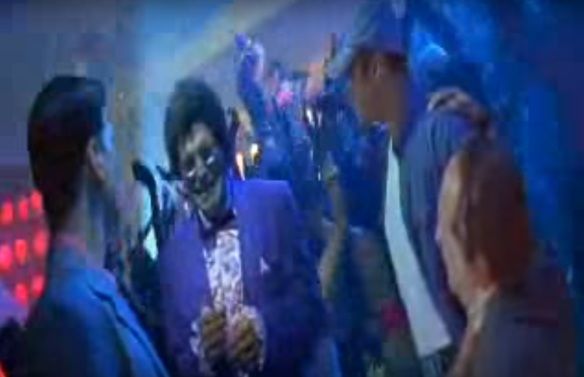
This is all stuff dealing with Preity’s image versus reality, but the same conflict is true of the other two leads as well. Akshay knows Preity will not fall in love with him as he is, and Salman knows that as well. It starts with a harmless suggestion of how to dress, how to approach her, what to say. But after their first interaction goes badly, Akshay begs Salman for another solution and they go full Cyrano. Akshay wears a wire and has Salman standing by to feed him every line. While Akshay is wearing a disguise on his soul, Salman is wearing several on his body. In order to stay in range and communicate, he buys a series of wacky costumes (actor, remember). Written out like that, it sounds kind of silly, but believe me, when you see it playing out in the song sequence below, it just breaks me, every time. For me, this and “Kwaja Mere Kwaja” from Jodha-Akbar are on the same level, amazing beautiful meditative pieces that take my soul to places it doesn’t even recognize. Again, just me.
This song sets the tone for all three characters. They feel uplifted, but what they are feeling does not match what they are seeing. That disconnect is what gives it it’s beauty. Akshay knows Preity is falling in love with him but feels that something is off and pushes Salman to keep helping him. Salman knows that he shouldn’t care for Preity anymore, that she ended their marriage heartlessly, but he can’t stop watching her. Preity is falling in love with Akshay but keeps feeling like she is with her ex-husband.
And then it all comes crashing in. Again. One by one, for the last half of the movie, the dominos fall. I’m not going to spoil the twist, but I am going to tell you it is beautifully done. Salman learns it first, and then has his heart broken. And the wall behind him shatters in a gorgeous use of CGI as his world ends.
In his heart break song, there are two shots that always get to me. First, when he is standing in the middle of time square, surrounded by people, and feeling completely empty inside (I know it is a cliche, but it really works here!). And second, when he goes back to the cafe where Anupum’s doppelganger works (don’t worry about it), and is taken in his arms and sobs. Such a beautiful scene of a stranger comforting a stranger.
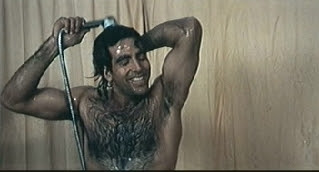
When Akshay learns his devastating truth, he has what might be the best acting moment of his career as he furiously rips off the clothes Salman bought him, brushes out his hair, puts on his glasses, literally breaks himself down and builds himself up again before our eyes. Also, there’s a moment when he’s shirtless and I always get distracted by how much stubble he has on his chest. It must be so itchy! Just go back to the old way! That hair that makes people go “why is he taking a shower in a sweater vest?”
And then Preity has the subtlest moment of them all, Akshay tells her what he has discovered, he goes on about all the details of it and how it happened, and all she says is, “Please, keep talking about Salman. I never hear anything good about him. Please, keep talking.” It’s heartbreaking! On all sides! You have poor Akshay, once more reduced to a side-note in their epic romance, and you have Preity’s response that quietly fills in the blank of her past two years, apparently spent being forced to listen to her family denigrate the man she loves (and by implication, all the decisions she made for herself about her life), until she is desperate to hear just one kind word about him.
Just when the emotions get to be too much, we get to the final happy ending, which is so beautiful that I bawl every time. Again, just me. I mean literally beautiful, as in how it looks, not what happens. I mean, what happens is nice too. But the visuals are just perfect. The whole movie has been about fantasy giving way to reality. In a whole bunch of different ways. Fantasy love stories, Salman’s fantasy of his career, Preity’s fantasies which were apparently pretty comprehensively crushed by her awful relatives before we ever met her in the present day-but what the ending tells us is that the fantasy may be over, but sometimes the reality is even more beautiful.
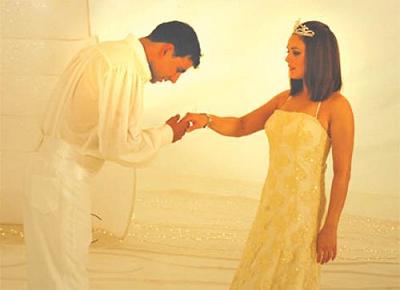
Way back at the beginning, Salman’s fantasy version of their romance ended when he destroyed their apartment, in gorgeous slow-motion, pulling down the yellow curtains first so they fell in the background before the glass and wood were shattered. In her new apartment, they watched her through yellow curtains which hung on either side of the window, showing on their pervy screen display like the side curtains at an old movie palace, framing their view of her. At the very end, he is on a soundstage back in Bombay, filming a part in what appears to be a low-budget romance in which he is merely the hero’s best friend. In the background, yellow draperies cheaply define the set area. Filming ends, the crowd disperses, and he sees Preity. As their eyes meet and they smile, the yellow curtains behind them slowly start to fall, the cheap artifice of film, the comfort of fantasy, everything we use to keep ourselves safe from what is real, falls away. And you see that they are standing on a hillside on a cloudy but beautiful day, and there was nothing to hide from after all. I swear, I am tearing up just thinking about it and I don’t even really know why!
And then there is an epilogue with a cheap pun on Preity Zinta’s name. It is just such an odd movie, but it is also the one I watch whenever I feel bad or sad or glad, or worried about the world, or need a good cry, or need to stop crying, or just need something beautiful. The title means “Life of my Soul”, and that’s really what it is for me! Again, just me.








 dontcallitbollywood